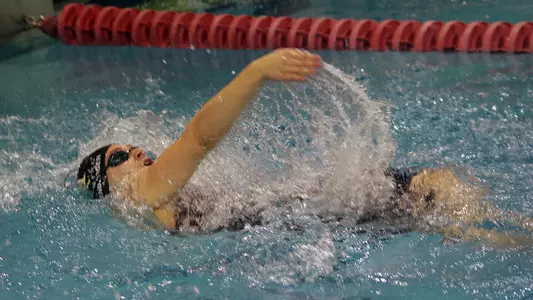
Shollenberger never gives up
2/8/2019 10:00:00 AM | Women's Swimming, Features
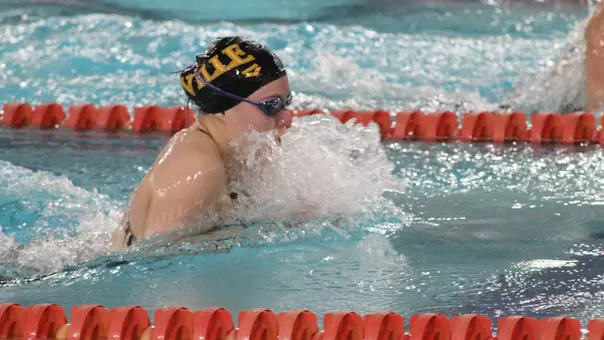
Millersville, Pa. – When there is not an obstacle to overcome for sophomore Alexis Shollenberger of the Millersville University women's swimming team, life gets boring.
Swimming keeps her going one day at time. While the usual student-athlete deals with time management, classroom work, part-time jobs, Shollenberger manages a cardiovascular system disorder called Postural Orthostatic Trachycardia Syndrome (POTS).
"Postural Orthostatic Tachycardia Syndrome is defined as 'a form of orthostatic intolerance that is associated with the presence of excessive tachycardia and many other symptoms upon standing or dysautonomia International,'" said Shollenberger. "In other words, when I am in an upright position--sitting or standing--my blood pools and my heart has to work harder to pump blood and oxygen to brain and other organs, resulting in dizziness, headaches, lack of focus, fainting, nausea, anxiety, and extreme fatigue."
The symptoms began in her freshman year of high school. By the end of the year, her body was so exhausted that she could barely finish races. She was fainting, becoming light headed to the point that she couldn't go to school.
After consulting with her pediatrician in October of 2014, she was diagnosed with POTS. Basically, when she stood up, the autonomic response to resist gravity and maintain blood access to her brain was affected.
"POTS has made me realize how important good dieting, exercising, and sleeping habits are to overall health," said Shollenberger. "Furthermore, it has taught me that time is valuable, since I only have a few very productive hours a day before medication wears off and the symptoms come back."
In high school, she shined in the pool, being named 2017 Academic All-American, 2016 All-State Honorable Mention and was a 2016 PIAA AAA State Finalist in the 200-freestyle relay. She also set the Central Pennsylvania Interscholastic Swimming League (CPL)'s record for 200-yard medley relay in 2015 with a time of 1:48.47. She qualified for PIAA District 3 in multiple events.
At one time she was a three-sport athlete who competed in water polo, track and field and swimming. But because of POTS, she had to give up a few sport because those sports had her competing vertically. Her blood flow would not allow it. The only sport that she was able to keep up was swimming because she could compete horizontally. Once she was diagnosed, the doctors recommended exercise in a horizontal form. Swimming became the best option. Swimming drastically helps Shollenberger's health. When she isn't swimming is when the complications arise.
"In swimming, it actually helps to exercise my heart," said Shollenberger. "So in doing cardio, it actually helps the symptoms of POTS. So when I stop swimming, it actually hurts my POTS in that I can't go to class or I get tired. Sitting, standing, everything, it hurts. I have bad posture, always hunched over so it is hard. It has a thing with ADHD because you have a brain fog so it is hard to pay attention."
In her senior year in high school Shollenberger tore her right labrum which stopped her from competing and getting some Division I offers. She tore her labrum due to swimming and overuse. She had a sling in a month in a half and went through physical therapy for three months. Even after all the recovery, she was not ready--physically or mentally--to get back into the pool until she got to Millersville.
"After being physically released, I tended to still have a mental block about pushing myself to another level," said Shollenberger. "However, my time here at Millersville has provided me with the resources to keep another injury from occurring. Not only do I feel great in the water, my confidence in my shoulder has been restored as well. Overcoming my shoulder injury fully has shown me that I can overcome any obstacles to come in the future."
The torn labrum is one thing but POTS is something that can't be made better through physical therapy. It is with Shollenberger. It also makes her susceptible to other illnesses.
"I had melanoma taken off my ear, I had the norovirus twice," said Shollenberger. "I get sick all the time because my POTS. It is just a part of my life. But it has become if I don't have an obstacle to overcome, it gets boring. Right now, it is nice that I don't have something but I have just learned to overcome and adapt."
"Alexis's hard work has set an incredible example for the rest of the team," said senior teammate Amanda Wetzler. "She is mentally and physically tough and sets the precedent for the exact way we need to practice every day. Alexis has internal motivation that drives her paired with a positivity and enthusiasm to succeed. She sets great goals and continues to be positive about each day and each practice."
In terms of Shollenberger's individual gains, she has started her first two collegiate swimming seasons by qualifying for the PSAC Championships. Last seaosn, Shollenberger recorded a 1:01.88 in the 100-yard backstroke prelims, qualifying her into her first conference championships final where she placed 24th. In the final of the 200-yard backstroke, Shollenberger finished in 16th with a time of 2:13.39.
This season, Shollenberger holds the team's best time in 50-yard freestyle. She surpassed her career top time in the 200-yard backstroke with a time of 2:12.61 at the F&M Invitational which broke the PSAC time standard, qualifying her for her second conference championships.
"Qualifying for PSACs is a big weight off your shoulders," said Shollenberger. "Doing it at Franklin & Marshall that is midway through the season means I have the rest of the season to not have to worry about making PSACs and get through practice and prepare for PSACs. It is just a big weight lift so it is really exciting."
Another obstacle that Shollenberger will have to face in the near future is her growth as a leader in and out of the pool. The West Lawn, Pa., native is a part of class including four others who look to lead the group in the next two years.
"I like the way Alexis comes in with a positive spin on the practice," said Wetzler. "I always know she will try her hardest and put focused effort into each repetition. Our team has benefited greatly from her positive leadership and her ability to have continued mental toughness."
She is a biology major who is looking to go into pre-med after graduation. Her POTS condition became a driving force behind deciding her major. She is hoping to help people who are going through what she has gone through and find a cure for the disease through research. She was influenced by her pediatrician who helped her in her everyday life. Shollenberger wants to give back to what he gave her.
"It is called the invisible disease for a reason because not a lot of people know what I am going through every single day," said Shollenberger. "A lot of people think I am just faking it and getting out of practice. No, I'm not. I hate when I see other people go through the same thing. That is what I want to do."
Be the first to know what's going on with the Marauders -- Follow @VilleMarauders on Twitter and Instagram, become a fan of Millersville Athletics on Facebook, visit our Social Media page and download our mobile app from the Apple Store and Google Play! To support the Marauders, join the Black & Gold Club.
Swimming keeps her going one day at time. While the usual student-athlete deals with time management, classroom work, part-time jobs, Shollenberger manages a cardiovascular system disorder called Postural Orthostatic Trachycardia Syndrome (POTS).
"Postural Orthostatic Tachycardia Syndrome is defined as 'a form of orthostatic intolerance that is associated with the presence of excessive tachycardia and many other symptoms upon standing or dysautonomia International,'" said Shollenberger. "In other words, when I am in an upright position--sitting or standing--my blood pools and my heart has to work harder to pump blood and oxygen to brain and other organs, resulting in dizziness, headaches, lack of focus, fainting, nausea, anxiety, and extreme fatigue."
The symptoms began in her freshman year of high school. By the end of the year, her body was so exhausted that she could barely finish races. She was fainting, becoming light headed to the point that she couldn't go to school.
After consulting with her pediatrician in October of 2014, she was diagnosed with POTS. Basically, when she stood up, the autonomic response to resist gravity and maintain blood access to her brain was affected.
"POTS has made me realize how important good dieting, exercising, and sleeping habits are to overall health," said Shollenberger. "Furthermore, it has taught me that time is valuable, since I only have a few very productive hours a day before medication wears off and the symptoms come back."
In high school, she shined in the pool, being named 2017 Academic All-American, 2016 All-State Honorable Mention and was a 2016 PIAA AAA State Finalist in the 200-freestyle relay. She also set the Central Pennsylvania Interscholastic Swimming League (CPL)'s record for 200-yard medley relay in 2015 with a time of 1:48.47. She qualified for PIAA District 3 in multiple events.
At one time she was a three-sport athlete who competed in water polo, track and field and swimming. But because of POTS, she had to give up a few sport because those sports had her competing vertically. Her blood flow would not allow it. The only sport that she was able to keep up was swimming because she could compete horizontally. Once she was diagnosed, the doctors recommended exercise in a horizontal form. Swimming became the best option. Swimming drastically helps Shollenberger's health. When she isn't swimming is when the complications arise.
"In swimming, it actually helps to exercise my heart," said Shollenberger. "So in doing cardio, it actually helps the symptoms of POTS. So when I stop swimming, it actually hurts my POTS in that I can't go to class or I get tired. Sitting, standing, everything, it hurts. I have bad posture, always hunched over so it is hard. It has a thing with ADHD because you have a brain fog so it is hard to pay attention."
In her senior year in high school Shollenberger tore her right labrum which stopped her from competing and getting some Division I offers. She tore her labrum due to swimming and overuse. She had a sling in a month in a half and went through physical therapy for three months. Even after all the recovery, she was not ready--physically or mentally--to get back into the pool until she got to Millersville.
"After being physically released, I tended to still have a mental block about pushing myself to another level," said Shollenberger. "However, my time here at Millersville has provided me with the resources to keep another injury from occurring. Not only do I feel great in the water, my confidence in my shoulder has been restored as well. Overcoming my shoulder injury fully has shown me that I can overcome any obstacles to come in the future."
The torn labrum is one thing but POTS is something that can't be made better through physical therapy. It is with Shollenberger. It also makes her susceptible to other illnesses.
"I had melanoma taken off my ear, I had the norovirus twice," said Shollenberger. "I get sick all the time because my POTS. It is just a part of my life. But it has become if I don't have an obstacle to overcome, it gets boring. Right now, it is nice that I don't have something but I have just learned to overcome and adapt."
"Alexis's hard work has set an incredible example for the rest of the team," said senior teammate Amanda Wetzler. "She is mentally and physically tough and sets the precedent for the exact way we need to practice every day. Alexis has internal motivation that drives her paired with a positivity and enthusiasm to succeed. She sets great goals and continues to be positive about each day and each practice."
In terms of Shollenberger's individual gains, she has started her first two collegiate swimming seasons by qualifying for the PSAC Championships. Last seaosn, Shollenberger recorded a 1:01.88 in the 100-yard backstroke prelims, qualifying her into her first conference championships final where she placed 24th. In the final of the 200-yard backstroke, Shollenberger finished in 16th with a time of 2:13.39.
This season, Shollenberger holds the team's best time in 50-yard freestyle. She surpassed her career top time in the 200-yard backstroke with a time of 2:12.61 at the F&M Invitational which broke the PSAC time standard, qualifying her for her second conference championships.
"Qualifying for PSACs is a big weight off your shoulders," said Shollenberger. "Doing it at Franklin & Marshall that is midway through the season means I have the rest of the season to not have to worry about making PSACs and get through practice and prepare for PSACs. It is just a big weight lift so it is really exciting."
Another obstacle that Shollenberger will have to face in the near future is her growth as a leader in and out of the pool. The West Lawn, Pa., native is a part of class including four others who look to lead the group in the next two years.
"I like the way Alexis comes in with a positive spin on the practice," said Wetzler. "I always know she will try her hardest and put focused effort into each repetition. Our team has benefited greatly from her positive leadership and her ability to have continued mental toughness."
She is a biology major who is looking to go into pre-med after graduation. Her POTS condition became a driving force behind deciding her major. She is hoping to help people who are going through what she has gone through and find a cure for the disease through research. She was influenced by her pediatrician who helped her in her everyday life. Shollenberger wants to give back to what he gave her.
"It is called the invisible disease for a reason because not a lot of people know what I am going through every single day," said Shollenberger. "A lot of people think I am just faking it and getting out of practice. No, I'm not. I hate when I see other people go through the same thing. That is what I want to do."
Be the first to know what's going on with the Marauders -- Follow @VilleMarauders on Twitter and Instagram, become a fan of Millersville Athletics on Facebook, visit our Social Media page and download our mobile app from the Apple Store and Google Play! To support the Marauders, join the Black & Gold Club.
Players Mentioned
Back/Free
/ Women's Swimming
Back/Free
/ Women's SwimmingThursday, December 14
Saturday, November 04
Saturday, October 21
Friday, January 13