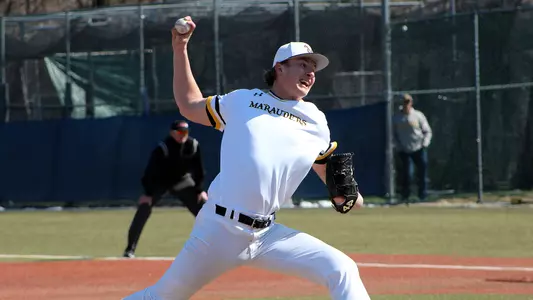
Yankosky embracing new role, delivering breakout season
4/5/2019 11:30:00 AM | Baseball, Features
MILLERSVILLE, Pa. - The numbers do not lie.
With 29 strikeouts in 19 2/3 innings, a 0.92 ERA, two saves and a 1-0 record, Tyler Yankosky as a reliever has been a game changer for the Marauders and a nightmare for PSAC hitters.
The conventions of baseball are changing. Roles are changing. Because offensive production statistically improves the third time through the lineup, starting pitchers aren't asked to go as deep into games. No longer are closers asked to get just three outs to end the game---get six or even nine. Some relievers start games as openers. Relief pitching is now about flexibility and coaches putting the best pitcher in the most high-leverage situations regardless of the inning.
That is why Yankosky is such a weapon for the Marauders. His overpowering fastball and high strikeout rate makes him an ideal closer. Yet his background that includes two seasons in the starting rotation gives Millersville head coach Jon Shehan the option to stretch him out over three or four innings or even use him on back-to-back days. In the PSAC East-opening Bloomsburg series, Yankosky pitched two shutout innings for a save in game one then came back in game in game four to bridge the middle innings and preserve a lead with 1 1/3 innings. The next weekend, he was Millersville's fourth pitcher out in game two and logged four shutout innings to polish off a win.
However, this bullpen stuff is all new to Yankosky. He prepared through the fall as if he would be in the rotation. It wasn't until he returned to campus in January that Shehan approached him about the change in roles.
"When we first got back, he threw it at me," said Yankosky. "'How do you feel about closing a game?' At first, I wasn't a fan of it. I was expecting to be a starter at that point. But it's what the team needs and it has worked out."
For Shehan, the decision came down to quality over quantity. Yankosky could start for any team in the PSAC but where would he be most effective for the Marauders?
"It has to do with depth," said Shehan. "A team in our league won a national championship a couple years ago and their best arm was their super reliever who came in during a lot of crucial situations and won them a lot of big games. It made me think. If we have an opportunity where we have a lot of starting pitching depth, could we take our best arm, put him in the bullpen and let him handle the biggest situations for us? We have depth this year with our starters and a really good bullpen. We can get creative with him.
"It's gauging if four or five innings over two days with better stuff, higher [velocity] and a harder breaking ball more important than getting 100 pitches in six innings in game four," continued Shehan. "We gambled. He would be an exceptional starter in our league. So far, it has paid off. His stuff is better, his velocity is better. His pitch mix has been really effective with two breaking balls."
From the first day that Yankosky stepped foot on the Cooper Park mound, he has possessed a tantalizing skill set: a 6-6, athletic frame, four pitches, a right arm that can dial up a 97 mile per hour fastball and a dive-bombing breaking ball. He won the PSAC East Freshman of the Year award in 2017 and made 13 starts as a weekend starter in 2018. He had all the look of a future ace and a high round draft choice but his production did match the stuff.
There were days like his complete-game, eight-strikeout performance against Shippensburg and the eight strikeouts in 4 2/3 shutout innings against NCAA regional qualifier Bloomsburg. But those days were mixed in with three runs on three hits and four walks allowed in three innings against Seton Hill in the PSAC Championship game and the six runs allowed on six hits and five walks in four innings against Charleston in the NCAA regional.
In his first two seasons, he gave up 108 hits and walked 69 in 116 1/3 innings for a 1.52 WHIP and a 5.38 ERA. Somehow, stuff that should be so unhittable was entirely hittable.
For Yankosky, the 2018 season was merry-go-round that wouldn't end. The mental game adversely effected his physical game, and the when the on-field performance suffered, it only made the mental side of the game more of a challenge.
"After a pretty successful freshman year I started setting higher goals. Last year went awful," said Yankosky. "I set goals too high and put too much pressure on myself…It started snowballing. When the year didn't start the way I wanted it to I put more pressure on myself to correct it. Mechanics went wrong. I didn't trust the fielders behind me and tried to strike out everybody. Then I would get wild and walk batters. When I did trust the fielders, I would get in a 2-0, 3-0 hole with the bases loaded. Everything went wrong from the start."
Shehan had seen that sophomore slump before. He watched future professional pitchers like Tim Mayza and Jim McDade as well as current senior Cordell Shannon go through it. Shehan also knew that Yankosky, like Mayza and others, would only get better.
"He had a tough year last year. Through the years we've seen that year-three progression," said Shehan. "It just takes time. You have to experience failure. For him to pitch the PSAC Championship game last year was a huge opportunity for him to learn. He's gotten better as a result."
Yankosky's improvement has been equal parts mechanics and mentality. He made subtle changes to his delivery in the offseason that are hardly noticeable but have made him more comfortable and helped him throw more strikes. More importantly, however, was that he didn't take the new role as a demotion. Embracing the opportunity to make the team better was vital to a successful transition.
"Starting pitchers always have an ego and they have to in order to be good," said Shehan. "The great ones all do. It was really important for Yank to maintain that. He did a nice job putting the team first but also maintaining his ego. You have to have an ego to be successful, but it can't be bigger than the team. He did a good job knowing that he could be more effective for the team by putting himself aside. It's been a good match."
"This year, I've gone out to have fun and it's turned around," said Yankosky.
Coming out of the bullpen has also freed his mind. Instead of trying navigating his way through a lineup for seven innings, Yankosky can cut loose every single pitch.
"As a starter, you pace yourself," said Yankosky. "You are always trying to go seven innings, saving something to get past 100 pitches. In a closer role, you have one inning. You have a lead, so blow it out and don't let them score. It is more of an intimidation factor."
While the transition has been seemingly seamless, Yankosky had reservations at first. A starter his entire career, Yankosky has had to change the way he practices and prepares. His No. 1 concern was throwing back-to-back days. As a starter, he would have a full week off between outings. Now, he may have only a few innings.
"Being a starter my whole life, you pitch one day a week and get that full rest," said Yankosky. "Now I might not get a full warmup and I might throw back-to-back days, which I've never done before. There were some concerns with that. But I read up on it and talked with coaches and built up confidence that I could do it. It just takes a little bit of adjusting.
"As a starter, you take your time; You have as much time as you want to get ready," said Yankosky. "In the bullpen, you get a couple of batters notice. You have to do things throughout the game to stay ready: go for a run every inning, do bands in between innings, play catch with the right fielder. You stay loose so when you get the call you are ready to go. You have to pay attention to the situations of the game so your mind is right."
Since allowing one run on two hits in three innings at Lander in the opening weekend of the season, Yankosky has given up just one run—a solo home run—in his last eight appearances spanning 16 2/3 innings. Yankosky in the bullpen is no longer an experiment. The results have given confidence to his teammates. Now, when he enters, it provides a jolt of energy. The team can't wait to see him fire fastballs and make hitters look silly with off-speed pitches.
"It's exciting," said Shehan. "Our team gets excited when he comes in to pitch. In my 12 years here, there have only been a handful of guys that the team gets excited about coming in. Right now, he leads a group of guys where they take the ball and the starter is not saying 'I hope he keeps the lead for me.' They know the game is pretty much over. Yankosky is at the forefront of that lineup we have coming out of the bullpen."
For Yankosky, the moment it all clicked was against Le Moyne in his sixth appearance of the season. Millersville jumped out to an early 4-0 lead but Le Moyne pulled within 5-4 heading into the eighth inning. Yankosky entered and struck out the side, getting the third batter swinging on a full count. Fully in the moment, he let out a yell after the final strike—a rare show of emotion from the quiet and reserved Yankosky. The Marauders fed off that energy, scored three runs in the bottom of the inning and pulled away.
Initially unsure of how this role would work, Yankosky now enjoys being a spark. That performance against Le Moyne was just the first of many game-changing moments likely to come for Yankosky. Playing in the postseason is an automatic for Millersville, and to compete for a regional championship, the team needs an arm like Yankosky's—one who can get the team out of a jam, lock down a win in the ninth or provide multiple innings to make up for a rough start. The Marauders need a pitcher who can deliver what they need on any given day.
"When the playoffs start and there are nine inning games, I'm not just a ninth inning guy," said Yankosky. "I can go three or four innings. I am used to seeing hitters two and three times through the lineup. I've faced every type of situation. For the team, if you have that guy in the bullpen, and you know he's your guy, you know it's our game to win."
FOLLOW THE MARAUDERS
• Be the first to know what's going on with the Marauders -- Follow @VilleMarauders on Twitter and Instagram, become a fan of Millersville Athletics on Facebook, visit our Social Media page and download our mobile app from the Apple Store and Google Play! To support the Marauders, join the Black & Gold Club.
With 29 strikeouts in 19 2/3 innings, a 0.92 ERA, two saves and a 1-0 record, Tyler Yankosky as a reliever has been a game changer for the Marauders and a nightmare for PSAC hitters.
The conventions of baseball are changing. Roles are changing. Because offensive production statistically improves the third time through the lineup, starting pitchers aren't asked to go as deep into games. No longer are closers asked to get just three outs to end the game---get six or even nine. Some relievers start games as openers. Relief pitching is now about flexibility and coaches putting the best pitcher in the most high-leverage situations regardless of the inning.
That is why Yankosky is such a weapon for the Marauders. His overpowering fastball and high strikeout rate makes him an ideal closer. Yet his background that includes two seasons in the starting rotation gives Millersville head coach Jon Shehan the option to stretch him out over three or four innings or even use him on back-to-back days. In the PSAC East-opening Bloomsburg series, Yankosky pitched two shutout innings for a save in game one then came back in game in game four to bridge the middle innings and preserve a lead with 1 1/3 innings. The next weekend, he was Millersville's fourth pitcher out in game two and logged four shutout innings to polish off a win.
However, this bullpen stuff is all new to Yankosky. He prepared through the fall as if he would be in the rotation. It wasn't until he returned to campus in January that Shehan approached him about the change in roles.
"When we first got back, he threw it at me," said Yankosky. "'How do you feel about closing a game?' At first, I wasn't a fan of it. I was expecting to be a starter at that point. But it's what the team needs and it has worked out."
For Shehan, the decision came down to quality over quantity. Yankosky could start for any team in the PSAC but where would he be most effective for the Marauders?
"It has to do with depth," said Shehan. "A team in our league won a national championship a couple years ago and their best arm was their super reliever who came in during a lot of crucial situations and won them a lot of big games. It made me think. If we have an opportunity where we have a lot of starting pitching depth, could we take our best arm, put him in the bullpen and let him handle the biggest situations for us? We have depth this year with our starters and a really good bullpen. We can get creative with him.
"It's gauging if four or five innings over two days with better stuff, higher [velocity] and a harder breaking ball more important than getting 100 pitches in six innings in game four," continued Shehan. "We gambled. He would be an exceptional starter in our league. So far, it has paid off. His stuff is better, his velocity is better. His pitch mix has been really effective with two breaking balls."
From the first day that Yankosky stepped foot on the Cooper Park mound, he has possessed a tantalizing skill set: a 6-6, athletic frame, four pitches, a right arm that can dial up a 97 mile per hour fastball and a dive-bombing breaking ball. He won the PSAC East Freshman of the Year award in 2017 and made 13 starts as a weekend starter in 2018. He had all the look of a future ace and a high round draft choice but his production did match the stuff.
There were days like his complete-game, eight-strikeout performance against Shippensburg and the eight strikeouts in 4 2/3 shutout innings against NCAA regional qualifier Bloomsburg. But those days were mixed in with three runs on three hits and four walks allowed in three innings against Seton Hill in the PSAC Championship game and the six runs allowed on six hits and five walks in four innings against Charleston in the NCAA regional.
In his first two seasons, he gave up 108 hits and walked 69 in 116 1/3 innings for a 1.52 WHIP and a 5.38 ERA. Somehow, stuff that should be so unhittable was entirely hittable.
For Yankosky, the 2018 season was merry-go-round that wouldn't end. The mental game adversely effected his physical game, and the when the on-field performance suffered, it only made the mental side of the game more of a challenge.
"After a pretty successful freshman year I started setting higher goals. Last year went awful," said Yankosky. "I set goals too high and put too much pressure on myself…It started snowballing. When the year didn't start the way I wanted it to I put more pressure on myself to correct it. Mechanics went wrong. I didn't trust the fielders behind me and tried to strike out everybody. Then I would get wild and walk batters. When I did trust the fielders, I would get in a 2-0, 3-0 hole with the bases loaded. Everything went wrong from the start."
Shehan had seen that sophomore slump before. He watched future professional pitchers like Tim Mayza and Jim McDade as well as current senior Cordell Shannon go through it. Shehan also knew that Yankosky, like Mayza and others, would only get better.
"He had a tough year last year. Through the years we've seen that year-three progression," said Shehan. "It just takes time. You have to experience failure. For him to pitch the PSAC Championship game last year was a huge opportunity for him to learn. He's gotten better as a result."
Yankosky's improvement has been equal parts mechanics and mentality. He made subtle changes to his delivery in the offseason that are hardly noticeable but have made him more comfortable and helped him throw more strikes. More importantly, however, was that he didn't take the new role as a demotion. Embracing the opportunity to make the team better was vital to a successful transition.
"Starting pitchers always have an ego and they have to in order to be good," said Shehan. "The great ones all do. It was really important for Yank to maintain that. He did a nice job putting the team first but also maintaining his ego. You have to have an ego to be successful, but it can't be bigger than the team. He did a good job knowing that he could be more effective for the team by putting himself aside. It's been a good match."
"This year, I've gone out to have fun and it's turned around," said Yankosky.
Coming out of the bullpen has also freed his mind. Instead of trying navigating his way through a lineup for seven innings, Yankosky can cut loose every single pitch.
"As a starter, you pace yourself," said Yankosky. "You are always trying to go seven innings, saving something to get past 100 pitches. In a closer role, you have one inning. You have a lead, so blow it out and don't let them score. It is more of an intimidation factor."
While the transition has been seemingly seamless, Yankosky had reservations at first. A starter his entire career, Yankosky has had to change the way he practices and prepares. His No. 1 concern was throwing back-to-back days. As a starter, he would have a full week off between outings. Now, he may have only a few innings.
"Being a starter my whole life, you pitch one day a week and get that full rest," said Yankosky. "Now I might not get a full warmup and I might throw back-to-back days, which I've never done before. There were some concerns with that. But I read up on it and talked with coaches and built up confidence that I could do it. It just takes a little bit of adjusting.
"As a starter, you take your time; You have as much time as you want to get ready," said Yankosky. "In the bullpen, you get a couple of batters notice. You have to do things throughout the game to stay ready: go for a run every inning, do bands in between innings, play catch with the right fielder. You stay loose so when you get the call you are ready to go. You have to pay attention to the situations of the game so your mind is right."
Since allowing one run on two hits in three innings at Lander in the opening weekend of the season, Yankosky has given up just one run—a solo home run—in his last eight appearances spanning 16 2/3 innings. Yankosky in the bullpen is no longer an experiment. The results have given confidence to his teammates. Now, when he enters, it provides a jolt of energy. The team can't wait to see him fire fastballs and make hitters look silly with off-speed pitches.
"It's exciting," said Shehan. "Our team gets excited when he comes in to pitch. In my 12 years here, there have only been a handful of guys that the team gets excited about coming in. Right now, he leads a group of guys where they take the ball and the starter is not saying 'I hope he keeps the lead for me.' They know the game is pretty much over. Yankosky is at the forefront of that lineup we have coming out of the bullpen."
For Yankosky, the moment it all clicked was against Le Moyne in his sixth appearance of the season. Millersville jumped out to an early 4-0 lead but Le Moyne pulled within 5-4 heading into the eighth inning. Yankosky entered and struck out the side, getting the third batter swinging on a full count. Fully in the moment, he let out a yell after the final strike—a rare show of emotion from the quiet and reserved Yankosky. The Marauders fed off that energy, scored three runs in the bottom of the inning and pulled away.
Initially unsure of how this role would work, Yankosky now enjoys being a spark. That performance against Le Moyne was just the first of many game-changing moments likely to come for Yankosky. Playing in the postseason is an automatic for Millersville, and to compete for a regional championship, the team needs an arm like Yankosky's—one who can get the team out of a jam, lock down a win in the ninth or provide multiple innings to make up for a rough start. The Marauders need a pitcher who can deliver what they need on any given day.
"When the playoffs start and there are nine inning games, I'm not just a ninth inning guy," said Yankosky. "I can go three or four innings. I am used to seeing hitters two and three times through the lineup. I've faced every type of situation. For the team, if you have that guy in the bullpen, and you know he's your guy, you know it's our game to win."
FOLLOW THE MARAUDERS
• Be the first to know what's going on with the Marauders -- Follow @VilleMarauders on Twitter and Instagram, become a fan of Millersville Athletics on Facebook, visit our Social Media page and download our mobile app from the Apple Store and Google Play! To support the Marauders, join the Black & Gold Club.
Players Mentioned

LHP
/ Baseball
RHP
/ BaseballFriday, May 22
Friday, May 22
Friday, May 15
Thursday, May 14