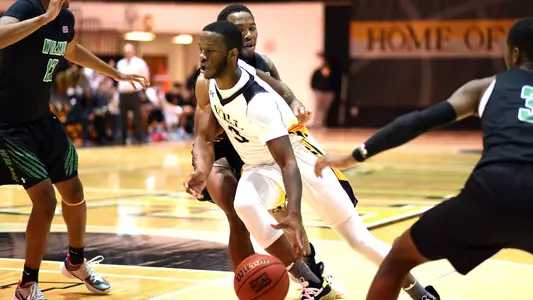
With help of Millersville staff, Faulkner is working his way back to being better than ever
1/20/2021 9:12:00 AM | Men's Basketball, Features
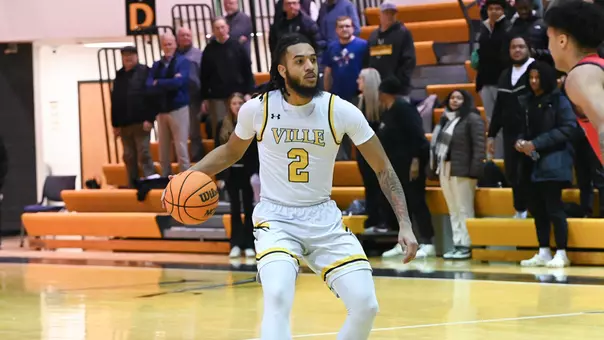
MILLERSVILLE, Pa. - The last time Millersville fans saw Jaden Faulkner play a basketball game in Pucillo Gymnasium, he put on a show with 18 points, seven assists and three steals in 26 minutes as the Marauders blew out Cheyney by 35 points. Late in the first half, Faulkner led a fast break at full-speed and as he neared the lane, he slammed on the brakes and hit a crossover dribble that made a defender stumble out of bounds, wiping out a referee in the process. Faulkner finished the highlight play with an over-the-shoulder, no-look pass to a teammate for an easy lay-up. The clip broadcast to the nation on ESPN's "Highly Questionable" the next morning.
That was on Nov. 18, 2019, and it won't be until sometime in November of 2021 that Marauder fans will get to see him play again. Two full years.
Six days after Faulkner's quintessential outing against Cheyney, and with the reigning PSAC East Athlete of the Week averaging 23.6 points, 6.8 rebounds and 6.2 assists per game, Faulkner tore an ACL while making a move to the hoop against Gannon. Immediately, his season ended. And then came COVID-19. Two years gone.
Had the 2020-21 season started on time, Faulkner very likely would have been in the starting lineup on opening night, but it was a grueling year of rehab that is an ongoing process. A devastating injury to a supremely gifted athlete like Faulkner can often present as many mental challenges as physical.
"I just thought I couldn't get better. The injury is gruesome. It plays with your mind when you are trying to recover," said Faulkner of the days following surgery. "As you come back, you are trying to relearn all your movements and get them back to the same or better, but it was hard just getting moving again."
The physical pain along with having the game of basketball taken away compounded the issue for Faulkner. The team had high hopes and had been playing like a team poised for successful season before Faulkner's injury. Without him, and with subsequent injuries to starters Caden Najdawi and Justin Nwosu, the Marauders floundered in December and early January. They lost five of seven games in the stretch after Faulkner went down and struggled mightily to create offense—the very thing that Faulkner does so well. Faulkner and his teammates, even the healthy ones, were in a funk.
"Watching was the hardest part," said Faulkner. "I felt like I couldn't help the team accomplish the goals we had set, like I let them down."
The disappointment had a direct effect on Faulkner's recovery process. He mentally checked out as the pain persisted and the team's on-court performance continued to struggle.
Enter Millersville athletic trainer Dr. Wendy Wheeler Dietrich.
Wheeler Dietrich had joined Millersville's training staff in the summer of 2019. When her work started with the basketball team, she quickly noticed an issue with Faulkner's biomechanics. The force with which he played, the lack of strength in his 19-year-old legs and an inward rotation of his knees upon impact gave him a predisposition to an ACL tear. She tried to work with him on strengthening his legs and correcting biomechanics but there wasn't enough time. It was almost as if his ACL was a ticking time bomb.
"I was traveling with the women's soccer team when the injury happened, and when I got the call from Gannon's trainer, I was disappointed, but I wasn't surprised," said Wheeler Dietrich.
From her 15 years of experience as an athletic trainer, Wheeler Dietrich knew the road that Faulkner was about to travel. The first step is pushing past the physical pain with a faith that you will be able to play again. That can be a serious challenge. It was for Faulkner. But an athletic trainer is much more than an athletic trainer. They can be part psychiatrist, part motivator, part confidant and part friend.
"After the injury I shut down. That's where Wendy came in," said Faulkner. "She told Coach (Casey) Stitzel that I needed to attack rehab hard and focus on everything, my hamstrings, my glutes. I wasn't attacking the rehab because I wasn't in it mentally. Wendy and Coach Stitzel got on me and ever since then I've been attacking it as hard as I can."
"He had this amazing ability, but he had never had an experience like this injury where he had work through it," said Wheeler Dietrich. "It was the unknown: 'Here where I am and I don't see the path forward. I don't see how I will be able to play the way I was before.' You are so disabled at the time. He is a very talented kid, on top of the world, and in a split second he can't walk on the court let alone play. He couldn't see the path forward, and that is common with a lot of athletes. It's disheartening."
With Wheeler Dietrich pushing him forward, Faulkner—and his teammates—had a change in mentality. He threw himself into rehab and became a coach on the sidelines, sharing his perspectives with fellow guards Khari Williams, James Sullivan and Mekhi Hendricks. He hopes to coach someday, so he used the injury as an opportunity to experience a different side of the game.
The team played better and Faulkner's knee got better.
"We started showing him little victories," said Wheeler Dietrich." We showed him the outcomes of what he'd already done, the expectations for what came next and what he will see. Once he hit those milestones the light bulb went off. Even showing tiny successes shows (athletes) it is possible; they are going to heal, and they will return to normal."
COVID-19 certainly threw a wrench into Faulkner's rehab plans, however. Right at the time when he and Wheeler Dietrich could get back on to a court and do basketball-related drills, gymnasiums and parks shut down everywhere.
"He wasn't able to touch a basketball for six months because the parks and gyms were closed," said Wheeler Dietrich. "The ability to get him on the court shows him that basketball is a thing again, not just walking and running, but 'oh yeah, I'm a basketball player too.'"
Determined as ever, Faulkner spent the summer on a virtually empty Millersville campus. He and Wheeler took all of the necessary precautions to continue the rehab: masks, social distancing and on and on.
"Jaden put himself in a bubble to continue to be here," said Wheeler Dietrich. "He sacrificed a lot of family time. He's been at Millersville alone a lot of the time. If he's going to put in that effort I have to at least match it."
The two worked mostly one-on-one for five days a week.
"Our relationship is like and a mom and son type thing," said Faulkner. "She's believing in me more than I believe in myself. I can't ask for anyone better than her. She's been doing a fantastic job, giving a 110 percent. She's battling the rehab with me."
There aren't any limitations for Faulkner now 13 months removed from the injury. But the strengthening of his body and reworking his biomechanics continues.
Faulkner and Wheeler Dietrich work on drills to improve lateral quickness. In the weight room, Faulkner pairs up with strength and conditioning coach Kyle Regensburg for a plan specifically structured to improve his explosiveness.
"The injury and procedure he went through isn't easy," said Regensburg. "Wendy reached out and said that Jaden was at a point where they couldn't continue the rehab from a strength building and power perspective in their clinic. We've continue to build off what Wendy had already been working on with developing lower body strength by squatting on one leg, squatting with two legs, using different types of jumps and really working on developing power and explosiveness. Typically, with an injury, the last thing to come back is the explosiveness because the athlete doesn't trust their body enough to put their foot in the ground and go. What we've been doing is putting him in positions to be explosive and move as fast as he can in a controlled way so he gain confidence in that leg again."
The injury could really be a blessing in disguise for the talented point guard. It's given him an opportunity to get stronger and faster and prevent future injuries.
"Injuries are a crazy thing and there's a lot that go into recovery. One of the secret blessings is that you can take time off and work on your body," said Regensburg. "You can work on your technique and form and physical qualities that you don't really have a chance to work on in basketball because it's such a long season. It's a great time for him to step back, work on getting stronger."
"He was worse off before he got injured because of his biomechanics. If he hadn't got injured, he never would have addressed those things," said Wheeler Dietrich.
Faulkner's primary basketball focus throughout rehab centered on his jump shot. As a player, he could get the rim at will. His court vision, defense and understanding of the game were excellent. But he knew, even before the injury, that to become the best version of himself, his outside shot needed to improve. A reliable 3-point shot (he's 15-of-56 in his career) would make him truly un-guardable.
"My jump shot was the No. 1 thing I worked on the whole time," said Faulkner.
"Even before he got hurt, he made a lot of progress with his shooting," said Millersville head coach Casey Stitzel. "His foul shooting percentages were way up, and as a shooting guy myself, that's the first step you see, increasing the foul shooting percentage. He was going to continue to trend upward. You can see that he was able to take his jumper to a new level. His balance is better. His form is better. He can turn into a really good shooter. He's put the time in."
Faulkner returned to the court for basketball activities with teammates during small pod workouts in the fall, playing three-on-three in the half court. He participated in the final two weeks of workouts before the semester ended. There were some butterflies for Faulkner but returning to the court provided an unmatched feeling of satisfaction and accomplishment.
"I get nervous every time I step on the court but once I start playing, those go away. I just need more reps and the more I play the better I get," said Faulkner. "I felt slow at first, but it was cool to be out there passing the ball again. The best feeling is seeing my teammates be happy to see me playing again. They encouraged me a lot. They push me to be the best player I can be."
"There are players that are talented, and he is that, but what makes him special is his IQ and feel," said Stitzel. "He was getting back in shape and not quite 100 percent, but what was still there was the way he passes the ball. He has the unique ability to make others better and sees things two and three plays ahead. You could see the energy level of the other players go up when he got out there. It was great to have him back because he's a coach on the court too."
Faulkner's play was special when he averaged 30 points, 9.0 rebounds and 6.5 assists in back-to-back games against Notre Dame College and Wilmington early in the 2019-20 season. It was a thrill to watch him score 35 points and absolutely take over a double overtime win against Kutztown as a freshman. Who could forget the game-winning buckets at Bloomsburg and Kutztown in back-to-back games? Two years is a long time, but from Wheeler Dietrich, to Regensburg, to Stitzel, they all say Faulkner will be even better in 2021-22. Faulkner believes it too. And he's already proved it in his rehab that with belief in himself, there's nothing that can stop him.
That was on Nov. 18, 2019, and it won't be until sometime in November of 2021 that Marauder fans will get to see him play again. Two full years.
Six days after Faulkner's quintessential outing against Cheyney, and with the reigning PSAC East Athlete of the Week averaging 23.6 points, 6.8 rebounds and 6.2 assists per game, Faulkner tore an ACL while making a move to the hoop against Gannon. Immediately, his season ended. And then came COVID-19. Two years gone.
Had the 2020-21 season started on time, Faulkner very likely would have been in the starting lineup on opening night, but it was a grueling year of rehab that is an ongoing process. A devastating injury to a supremely gifted athlete like Faulkner can often present as many mental challenges as physical.
"I just thought I couldn't get better. The injury is gruesome. It plays with your mind when you are trying to recover," said Faulkner of the days following surgery. "As you come back, you are trying to relearn all your movements and get them back to the same or better, but it was hard just getting moving again."
The physical pain along with having the game of basketball taken away compounded the issue for Faulkner. The team had high hopes and had been playing like a team poised for successful season before Faulkner's injury. Without him, and with subsequent injuries to starters Caden Najdawi and Justin Nwosu, the Marauders floundered in December and early January. They lost five of seven games in the stretch after Faulkner went down and struggled mightily to create offense—the very thing that Faulkner does so well. Faulkner and his teammates, even the healthy ones, were in a funk.
"Watching was the hardest part," said Faulkner. "I felt like I couldn't help the team accomplish the goals we had set, like I let them down."
The disappointment had a direct effect on Faulkner's recovery process. He mentally checked out as the pain persisted and the team's on-court performance continued to struggle.
Enter Millersville athletic trainer Dr. Wendy Wheeler Dietrich.
Wheeler Dietrich had joined Millersville's training staff in the summer of 2019. When her work started with the basketball team, she quickly noticed an issue with Faulkner's biomechanics. The force with which he played, the lack of strength in his 19-year-old legs and an inward rotation of his knees upon impact gave him a predisposition to an ACL tear. She tried to work with him on strengthening his legs and correcting biomechanics but there wasn't enough time. It was almost as if his ACL was a ticking time bomb.
"I was traveling with the women's soccer team when the injury happened, and when I got the call from Gannon's trainer, I was disappointed, but I wasn't surprised," said Wheeler Dietrich.
From her 15 years of experience as an athletic trainer, Wheeler Dietrich knew the road that Faulkner was about to travel. The first step is pushing past the physical pain with a faith that you will be able to play again. That can be a serious challenge. It was for Faulkner. But an athletic trainer is much more than an athletic trainer. They can be part psychiatrist, part motivator, part confidant and part friend.
"After the injury I shut down. That's where Wendy came in," said Faulkner. "She told Coach (Casey) Stitzel that I needed to attack rehab hard and focus on everything, my hamstrings, my glutes. I wasn't attacking the rehab because I wasn't in it mentally. Wendy and Coach Stitzel got on me and ever since then I've been attacking it as hard as I can."
"He had this amazing ability, but he had never had an experience like this injury where he had work through it," said Wheeler Dietrich. "It was the unknown: 'Here where I am and I don't see the path forward. I don't see how I will be able to play the way I was before.' You are so disabled at the time. He is a very talented kid, on top of the world, and in a split second he can't walk on the court let alone play. He couldn't see the path forward, and that is common with a lot of athletes. It's disheartening."
With Wheeler Dietrich pushing him forward, Faulkner—and his teammates—had a change in mentality. He threw himself into rehab and became a coach on the sidelines, sharing his perspectives with fellow guards Khari Williams, James Sullivan and Mekhi Hendricks. He hopes to coach someday, so he used the injury as an opportunity to experience a different side of the game.
The team played better and Faulkner's knee got better.
"We started showing him little victories," said Wheeler Dietrich." We showed him the outcomes of what he'd already done, the expectations for what came next and what he will see. Once he hit those milestones the light bulb went off. Even showing tiny successes shows (athletes) it is possible; they are going to heal, and they will return to normal."
COVID-19 certainly threw a wrench into Faulkner's rehab plans, however. Right at the time when he and Wheeler Dietrich could get back on to a court and do basketball-related drills, gymnasiums and parks shut down everywhere.
"He wasn't able to touch a basketball for six months because the parks and gyms were closed," said Wheeler Dietrich. "The ability to get him on the court shows him that basketball is a thing again, not just walking and running, but 'oh yeah, I'm a basketball player too.'"
Determined as ever, Faulkner spent the summer on a virtually empty Millersville campus. He and Wheeler took all of the necessary precautions to continue the rehab: masks, social distancing and on and on.
"Jaden put himself in a bubble to continue to be here," said Wheeler Dietrich. "He sacrificed a lot of family time. He's been at Millersville alone a lot of the time. If he's going to put in that effort I have to at least match it."
The two worked mostly one-on-one for five days a week.
"Our relationship is like and a mom and son type thing," said Faulkner. "She's believing in me more than I believe in myself. I can't ask for anyone better than her. She's been doing a fantastic job, giving a 110 percent. She's battling the rehab with me."
There aren't any limitations for Faulkner now 13 months removed from the injury. But the strengthening of his body and reworking his biomechanics continues.
Faulkner and Wheeler Dietrich work on drills to improve lateral quickness. In the weight room, Faulkner pairs up with strength and conditioning coach Kyle Regensburg for a plan specifically structured to improve his explosiveness.
"The injury and procedure he went through isn't easy," said Regensburg. "Wendy reached out and said that Jaden was at a point where they couldn't continue the rehab from a strength building and power perspective in their clinic. We've continue to build off what Wendy had already been working on with developing lower body strength by squatting on one leg, squatting with two legs, using different types of jumps and really working on developing power and explosiveness. Typically, with an injury, the last thing to come back is the explosiveness because the athlete doesn't trust their body enough to put their foot in the ground and go. What we've been doing is putting him in positions to be explosive and move as fast as he can in a controlled way so he gain confidence in that leg again."
The injury could really be a blessing in disguise for the talented point guard. It's given him an opportunity to get stronger and faster and prevent future injuries.
"Injuries are a crazy thing and there's a lot that go into recovery. One of the secret blessings is that you can take time off and work on your body," said Regensburg. "You can work on your technique and form and physical qualities that you don't really have a chance to work on in basketball because it's such a long season. It's a great time for him to step back, work on getting stronger."
"He was worse off before he got injured because of his biomechanics. If he hadn't got injured, he never would have addressed those things," said Wheeler Dietrich.
Faulkner's primary basketball focus throughout rehab centered on his jump shot. As a player, he could get the rim at will. His court vision, defense and understanding of the game were excellent. But he knew, even before the injury, that to become the best version of himself, his outside shot needed to improve. A reliable 3-point shot (he's 15-of-56 in his career) would make him truly un-guardable.
"My jump shot was the No. 1 thing I worked on the whole time," said Faulkner.
"Even before he got hurt, he made a lot of progress with his shooting," said Millersville head coach Casey Stitzel. "His foul shooting percentages were way up, and as a shooting guy myself, that's the first step you see, increasing the foul shooting percentage. He was going to continue to trend upward. You can see that he was able to take his jumper to a new level. His balance is better. His form is better. He can turn into a really good shooter. He's put the time in."
Faulkner returned to the court for basketball activities with teammates during small pod workouts in the fall, playing three-on-three in the half court. He participated in the final two weeks of workouts before the semester ended. There were some butterflies for Faulkner but returning to the court provided an unmatched feeling of satisfaction and accomplishment.
"I get nervous every time I step on the court but once I start playing, those go away. I just need more reps and the more I play the better I get," said Faulkner. "I felt slow at first, but it was cool to be out there passing the ball again. The best feeling is seeing my teammates be happy to see me playing again. They encouraged me a lot. They push me to be the best player I can be."
"There are players that are talented, and he is that, but what makes him special is his IQ and feel," said Stitzel. "He was getting back in shape and not quite 100 percent, but what was still there was the way he passes the ball. He has the unique ability to make others better and sees things two and three plays ahead. You could see the energy level of the other players go up when he got out there. It was great to have him back because he's a coach on the court too."
Faulkner's play was special when he averaged 30 points, 9.0 rebounds and 6.5 assists in back-to-back games against Notre Dame College and Wilmington early in the 2019-20 season. It was a thrill to watch him score 35 points and absolutely take over a double overtime win against Kutztown as a freshman. Who could forget the game-winning buckets at Bloomsburg and Kutztown in back-to-back games? Two years is a long time, but from Wheeler Dietrich, to Regensburg, to Stitzel, they all say Faulkner will be even better in 2021-22. Faulkner believes it too. And he's already proved it in his rehab that with belief in himself, there's nothing that can stop him.


Players Mentioned

G
/ Men's Basketball
G
/ Men's Basketball
F
/ Men's Basketball
F
/ Men's Basketball
G
/ Men's Basketball
G
/ Men's BasketballThursday, March 05
Thursday, February 26
Thursday, February 26
Saturday, February 14