Losing not an option: Celebrating the 25th anniversary of the 1995 football season
Ethan Hulsey, Director of Athletic Communications
10/28/2020
We were teammates, and we took pride in that. We didn’t want to let each other down. We were very proud to be Marauders.Robert Drumwright
Somewhere, in a closet, maybe in a box in the basement, Greg Moylan still has the t-shirt. Well worn, faded after 25 years, but the memories the shirt harkens are as clear and bright as ever. And the four words screened on the shirt “Losing not an option” wasn’t just a design. It was a mission and a goal realized by a superbly talented football team, one that was forged and refined in the competitive fires of practices—a daily battle of offense-defense one-upmanship that made it one of two teams ever at Millersville to not lose a regular season game. The 1995 team hold a special status in the legacy of Millersville Marauders football.
A big-play offense, a game-changing special teams unit and a mean, nasty defense brought a 9-0-1 regular season record, 40 individual and team records and an NCAA Division II Playoff berth that had been so elusive in the six years after the program’s last trip to the postseason. In the modern era of geographically smaller super regions and 28 qualifying teams, Millersville’s 1990, 1992, 1993 and 1994 teams all would have had strong playoff resumes. Juniors and seniors on the 1995 team went 8-2 and undefeated in the PSAC East two years prior. In 1994, the Marauders again went 8-2 with those losses coming by a combined total of 12 points. But in 1995, with only 16 teams in the nation reaching the playoffs, the margin for error was razor thin. The 1995 team desperately wanted to reach the NCAA Playoffs, and evidently, the only way to get there was to play perfectly. Losing could not be an option.
“We felt in previous years that we should have made the playoffs,” said Gerald “Scottie” Mack, a junior running back on the team and a Millersville Athletics Hall of Fame member. “Our mission, as well as winning the (PSAC) East, was getting to the playoffs. We had been highly disappointed that we hadn’t before. That was the mission.”
“We didn’t talk about it on a daily or weekly basis, but as 18, 19, 20-year-old guys, we knew what was on the line,” said the team’s quarterback Greg Moylan. “We knew if we dropped one it was going to be an uphill battle. That PSAC East was a good football conference. You had some legitimate teams. But the coaches were always preaching, ‘it’s who’s in front of us Saturday. We execute like we can it’s all going to take care of itself.’ It absolutely did… We knew what was at stake. We knew where stood. We knew where we wanted to get to, and we absolutely had the team to get us there.”
For the 1995 Marauders, the most competitive and intense games weren’t played on Saturdays. Those came after classes, in the afternoons, on the practice field. The defense ranked No. 1 in the PSAC that season and became known as “Blitz-Ville” because of the relentless and unorthodox pressures dialed up against the opposition. The offense, led by the ultra-dynamic wide receiver Kevin Cannon, a Harlon Hill Trophy finalist and future Millersville Athletics Hall of Fame member, also featured a superbly accurate passer in Moylan, an all-around tight end in Mark Harmon, a trio of game-breaking running backs in Mack, Berton Cannon (Kevin’s younger brother) and Brady Myers with an offensive line anchored by all-region tackle and all-time character Tim Sorber. With all that talent, the daily competition was legendary.
“Even our offense, they hated going against us in practice,” said Robert Drumwright, a junior safety in 1995. “Every week, during blitz period, they would think one player was coming and somebody else was coming.”
“It’s true,” Moylan agreed. “That’s what made us such a great team, going against those guys every day in practice. We had some stud (defensive) lineman: Jes Kaercher, Shippy (Bob Shipp), John Aument. We knew that if we could compete against our defense, we would be alright come Saturday against these other teams. It was absolutely those guys who helped shape our offense and helped us execute on Saturdays.”
The practices were physical and intense. Mack remembers that there were no flags for holding, face masks or personal fouls. Each day was a battle to make each other better.
“It started off in camp with (offensive lineman) Tim Sorber and (linebacker) Rick Boyer fighting each other,” said Moylan. “The environment was so competitive because each side wanted to win, had to win, had to dominate the other side. I don’t know if there was ever an instance where a one side dominated the other for a whole practice. It was so evenly matched. At the end of practice, we were all teammates. We were out there on the field to work. There were times we wanted to kill each other on the field. We had so many competitive, ultra-competitive guys on that team. The talent level was so high, and the guys knew what was in front of us. We had to make this thing work.”
Even 25 years later, the offense-defense rivalry continues.
“When we dominated (the offense), the drills were quick,” retorted Drumwright. “If ya’ll were kicking our a**, that drill would last for an hour. If (the offense) had the better hand, coach would keep that drill going.”
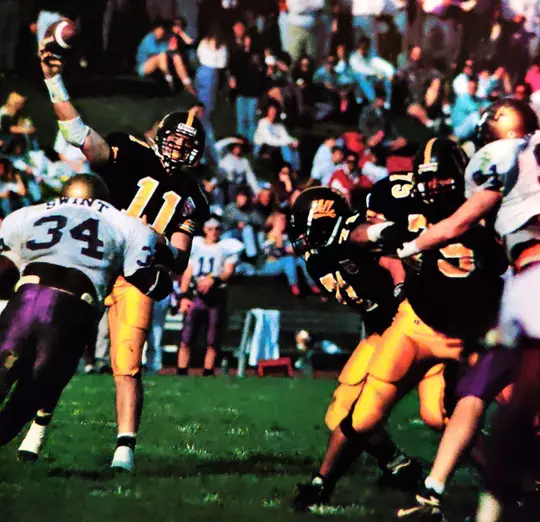
The competitiveness of the players permeated into the position groups as well. Mack, Myers and the younger Cannon battled for playing time all season. Mack, a track speedster and two-time PSAC champion in the 100-meter, 200-meter dashes, finished third in the nation in the 100 with a school and PSAC record time of 10.26. He also led the football team with 663 yards rushing in 1995. But Myers and Cannon also rushed for over 500 yards and all three players averaged 4.9 yards per carry or better. All three broke touchdown runs of at least 48 yards. When Mack suffered injuries late in the season, Myers ran for 237 yards and a school-record five rushing touchdowns against Cheyney. The desire for more touches pushed the players to perform their best each day, and every touch was an opportunity.
“We were so competitive because there were always three running backs that played,” said Mack. “We kind of had different roles, so I knew that if I got tackled at the five, I wasn’t getting back in. You’ve got to take the most of your opportunity. You had to fight for every yard because that next guy was coming in. There was no fumbling. If you fumbled you went to the back of the line. Our film sessions were highly competitive. We would just kill each other because we knew there were three guys there. Practice was highly competitive, highly critiqued and you had to be sharp every single practice and every single week.
The running game was certainly potent, but the ’95 Marauders boasted a balanced offensive attack, rushing for 2,100 yards and passing for 2,505. Moylan, in his second year as a starter, set Millersville records for completions (175), completion percentage (.636), yards (2,310) and touchdowns (22) while throwing only six picks.
“Greg was very good in terms of accuracy, looking us off,” said Drumwright of the team’s quarterback. “He was a team leader. He did a very good job of reading the defense and knowing where to go with the ball. Greg didn’t make a lot of mistakes throwing the ball into bad situations.”
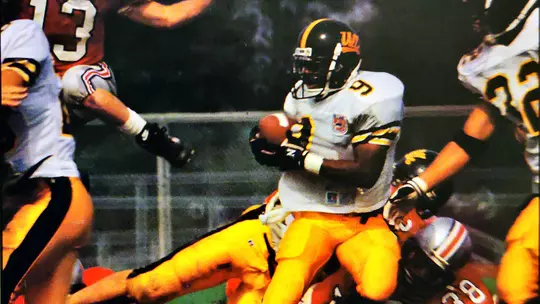
Moylan’s favorite target was the incomparable Kevin Cannon who compiled 918 yards and 11 touchdowns through the air, returned two of his 14 kickoffs for touchdowns, averaging 33.1 yards per return, and recorded a punt return touchdown in just 16 tries as well. He did that all that in basically seven regular season games. He was injured in the second quarter of the East Stroudsburg game, did not play against Cheyney, and was limited in the finale against Mansfield. He led Division II in punt return average and ranked third in kick returns. On the way to an All-America honor and fifth-place finish in the Harlon Hill voting, Cannon broke 14 school records.
“He made my life easy,” said Moylan of Cannon. “I had the confidence he was going to be in the right place. I never second guessed ‘is he going to read this the same way I’m going to read this?’ The guy was extremely football smart. At 5-6, 5-7, he could get open, find the seams, and find the holes. I couldn’t have felt more comfortable throwing to any receiver than Kevin Cannon. If the ball was in the vicinity, somehow, someway he would track it down and get the ball. He knew how to run his routes. For a quarterback, it comes down to trust. There was never a doubt.”
Ranking No. 2 on the team in receiving yards that season was tight end Mark Harmon, who Moylan calls arguably the best tight end Millersville ever had. James Duckett was the rangy target, adding eight touchdown catches.
With the home-run potential of Mack and the Cannon brothers, the offense could score on almost any play. The same could be said of the return game, where Cannon made life a nightmare for the opposition.
“Our special teams were scary,” said Mack. “What made Kevin so great was that teams were scared to punt and kickoff the ball. If they did score, they had to kick it off to one of the best players in the country. We worked hard on that. With Kevin back there, we knew not to clip, not to hold, because if you can give Kevin a chance he would put us in a great situation. Kevin was exciting, electrifying. He could shake you out of your shoes. The special teams were an extra weapon we had that made us more potent.”
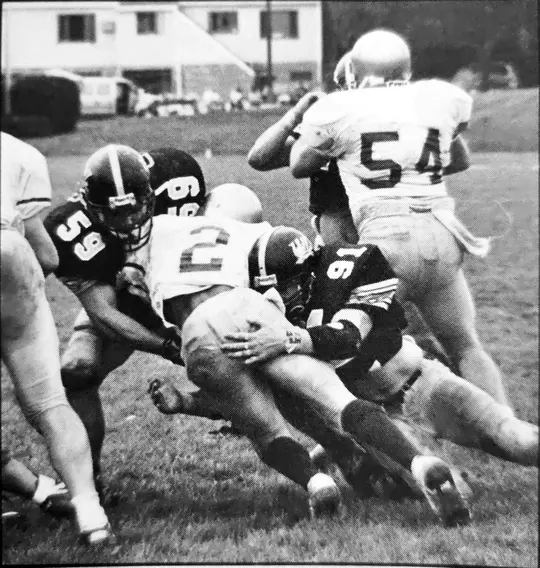
Millersville’s defense limited opposing teams to just 13.9 points per game, so Cannon had to make the most of his few kick return opportunities. Remarkably, the ’95 defense allowed just one first quarter touchdown all season, allowing Millersville to hold a 220-64 advantage in first half scoring on the season. The defense limited teams to 2.01 yards per carry on the ground, a 42.9 completion percentage, and opponents converted just 24 percent of their third downs.
“Team speed,” said Drumwright of what made the defense special. “We had a very, very fast defense and we played the run very well. We were going to force you to throw, and throwing the ball wasn’t going to be easy either because we’d send seven, eight-man pressures, and teams couldn’t handle it. They didn’t know what to look for.
Coordinated by Bob Forgrave, the defense utilized a 4-3 alignment but often incorporated four linebackers. The schemes were complex, and Drumwright recalls watching the famed zone blitz packages of the early 90s Pittsburgh Steelers concocted by Dick LeBeau and implementing those defenses at Millersville.
Drumwright was a two-time All-PSAC East First Team performer, and his fellow safety, Dale Reed, earned two All-PSAC East First Team mentions himself. Reed’s ’95 performance broke records as he picked off seven passes in the regular season and one more in the playoffs for the single-season school record.
A stout front seven suffocated opposing offenses. The line included Jamar Gordon (9 ½ sacks), John Aument (8 sacks), Bob Shipp (5 sacks) and Jes Kaercher (4 sacks). Kaercher was already a two-time All-PSAC East selection heading into his senior year. Linebacker Shawn Landis, named the team’s defensive MVP and a senior captain, totaled 99 tackles and four sacks in the regular season. Rick Boyer set the Millersville career record for solo tackles (285) and piled up 103 tackles with a team-leading 10 ½ sacks. Chris Caserio and Steve Reinoehl ranked third and fifth on team in tackles and both went on to become All-PSAC East performers.
“We sent the heat,” said Drumwright. “It made my job a lot easier. I knew I only had to cover for three seconds, because if they didn’t get it off in three to four seconds, between Jamar Gordon, Shippy, Aument, Kaercher, and our linebacker crew—we went four to five deep. Those guys would have started anywhere else in the PSAC. On our team they were reserves and brought in for special defenses. We had a tough front seven, which made my job way easier. When it came to throwing the ball, I knew I wasn’t out there on the island for very long.”
After the ferocity of intersquad battles in camp, the Marauders were more than excited to punish an opponent, and the team’s talent went on full display in the opening three games. Cannon lit up Shepherd for a school record five receiving touchdowns in the opener. Millersville rolled through American International and Shippensburg by a combined 118-10. A see-saw battle with Clarion in week four proved closer than expected, but a Mack breakaway touchdown put the 41-35 win away while Moylan piled up a school record 444 passing yards.
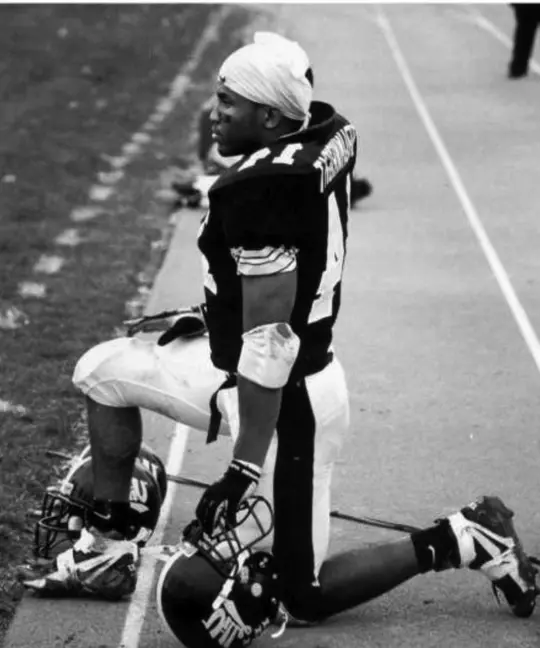
The week five showdown at Bloomsburg pitted arguably the two best teams in the PSAC. Cannon took the opening kickoff back for a touchdown, and leading 21-20 in the fourth quarter, Millersville drove 76 yards for an eight-point lead on a seven-yard Mack touchdown run. But there was controversy ahead. With under three minutes remaining, Bloomsburg traveled 83 yards and scored a touchdown to make it a two-point game. With no overtime in the college game in 1995, Bloomsburg needed a two-point conversion to force a tied game. Bloomsburg called on its quarterback to sprint to his right where he fired a pass. Drumwright, running in stride with the intended wide receiver, dove and batted the pass away with his right hand. But he was flagged for a debatable pass interference penalty. Drumwright’s teammates had mobbed him in celebration before the flags hit the turf.
“I thought Robert Drumwright made an outstanding play,” said then-Millersville head coach, the late Gene Carpenter, in an interview after the season. “Everybody who saw the film thought it was an outstanding play. Unfortunately, the official thought he saw something and threw the flag. That really hurt because our team was already celebrating on the sidelines, our kids were jumping on each other out on the field before the flag even hit the ground.”
“I can go back and watch that a thousand times, and I’ll go to my grave saying it was a terrible call,” said Moylan.
“I worked with the wide receiver from Bloomsburg and even he said ‘yo, that was a bad call,’” said Drumwright. “He gave me a picture of that play, and I still have it to this day. He said he thought that the game was over until he was told there was a flag on the ground.”
Bloomsburg ran a similar play on its do-over PAT and connected in the back-right corner of the end zone for a 28-28 tie.
For team bent on perfection, the tie felt more like a devastating defeat.
“I remember being so angry, feeling like we lost and Caserio crying like a family member had died,” recalled Mack. “He never sobbed like that after a loss. That was a tie. We didn’t lose but it still feels like a loss.”
“After the game, Carp got us all huddled around,” said Moylan. “His message was ‘hey, this ain’t over. This is a blip. This is a tie. This isn’t going to define our season.’ What he focused on, rather than what people would say wasn’t the right call, he didn’t harp on that. He said, ‘hey, we were probably unlucky, but we need to regroup.’”
Drumwright and his teammates thought that one tie would be enough to keep them out of the playoffs once again, and unbelievably, it very nearly did. Ranked No. 9 in the nation the week of the Bloomsburg game, Millersville dropped all the way out of the national rankings after the tie and did not return to the top 20 until week eight. Even with a 9-0-1 record (and the tie coming on the road), the Marauders snuck in with the final seed in the Northeast Region. Bloomsburg, which finished 9-1-1, was left out.
The questionable call made Drumwright somewhat of a scapegoat against Bloomsburg, but he made amends the very next week against a Kutztown team led by future NFL first round pick John Mobley. The Marauders, possibly lost in the fog of the previous’ week’s unimaginable finish, trailed the visiting Golden Bears 20-7 with under 10 minutes remaining. To make the predicament worse, Moylan had been knocked out of the game in the third quarter, and Mack and Cannon were sidelined with injuries.
“We had quite a few of our offensive weapons banged up. Defensively, it was a hangover,” said Drumwright. “We were out of it. Plays that were happening, it was like, ‘how did this kid catch a 40-yard pass? What’s going on?’”
“I remember our coaches grinding on us at halftime, and I mean grinding on us,” said Mack. “I know (I was in a fog) because I didn’t even remember Moylan getting knocked out. I was standing there thinking, ‘why is (back-up quarterback Mike Dunkerley) calling the plays?’ I could see it, hear it, but kept thinking, ‘why is Dunkerley in the game?’ I was in space. I remember looking at the scoreboard, and it was 20-7 and thinking, ‘we are losing to Kutztown.’”
Reserve defensive end Jon Givens provided a game-turning play, forcing a fumble deep in Kutztown territory. It took Millersville nine plays to pick up the two yards it needed, and drives were twice kept alive by Kutztown penalties. On fourth down, Duckett caught a fade from Dunkerley for six. The defense responded with another stop, and then Cannon, who had recently returned to the game, worked his special teams magic.
Receiving the punt on his own 25, Cannon slipped through four would-be tacklers in the first 10 yards and worked his way to the Millersville sideline where he was hemmed in by three Kutztown players. Cannon stopped on a dime, juked back to the middle of the field, leaving the three Golden Bears grasping at air. He sprinted past one white jersey and barreled through the arms of another tackler at the Kutztown 40. A Golden Bear finally grabbed him by the shoulder pad at the 20, but Cannon dragged the tackler another seven yards before the remarkable return ended at the 13.
“I’ll never forget this run as long as I live,” said Carpenter after the season.
“That special teams play turned the game around, Kev skating on the sideline,” said Mack. “It got us out of the fog.”
Cannon’s heroics weren’t finished. On the very first offensive snap, he made a diving catch at the one-yard line, setting up Myers’ one-yard TD run.
Kutztown still had time to rally from the 21-20 deficit, but Drumwright put the exclamation point on the dramatic victory with a win-clinching interception.
“That was a game where good teams find a way to win,” said Moylan. “We were absolutely the better, more talented team. That was a game where we needed to find a way to win. I think the defense kept us in it because the offense struggled mightily that day. It was one of those days. It was a great example of good teams knowing how to win and finding a way to get there.
“If we lose that game it’s lights out, over,” said Moylan.
Back on track, Millersville rolled at West Chester the following week. Mack finished the 31-12 victory with a 72-yard touchdown run. The Marauders then squeezed by East Stroudsburg 19-14 before blasting Cheyney 54-0 and Mansfield 41-20.
A 9-0-1 record, Millersville’s first unbeaten season in 55 years, and a PSAC East title--all that was left was the waiting. There were no streaming or televised NCAA selection shows in 1995. The team had refused to lose and didn’t but still questioned if it’s accomplishments would be enough.
“Carp pulled us all together in a big room on campus,” said Moylan. “He called us in for a team meeting. and we didn’t know if we were going or not going. ‘Gentlemen, we made it and we are playing Ferris State’ he said. And we said, ‘who is that and where is that?’
“There was a hell of a lot of excitement in that room,” said Moylan. “At first we were quiet because we were trying to figure out who was Ferris State, but what we set out to do we accomplished, and it was a great feeling.”
Ferris State, located in Big Rapids, Michigan, landed the No. 1 seed in the region, 10-0 and ranked No. 3 in Division II. The Marauders arrived on a chartered flight and found a snow-covered campus with a half-frozen, sloppy field. Moving with uneasy footing negated Millersville’s speed advantage, but the Marauders still led 13-6 at the half. The Marauders, however, drew some bad breaks in the second half. Two big plays, including a Mack touchdown run, got called back on penalties. Moylan had Cannon running wide open for a potential touchdown connection but slipped in the backfield without a defender nearby.
“There was a huge play in that game that we did a lot of film study for,” said Moylan. “We knew they had aggressive safeties. We had a beautiful play call to Kevin that he ran a deep post. I dropped back and my feet just go right out from under me on that slippery field. If I had missed that throw, there was no one within 30 yards of him--easy touchdown. There were a couple of plays like that in the game.”
Ferris State scored 21 points in the fourth quarter to beat the Marauders, 36-26. Moylan completed 24-of-40 passes for 263 yards and four touchdowns. Millersville Athletic Hall of Famer and former sports information director Greg Wright wrote that Moylan “clearly outplayed his counterpart, Harlon Hill finalist Bill Love of Ferris State.”
“We were hands down the better team,” said Moylan. “It was an unfortunate day. A tough pill to swallow. Yes, we lost, but that was a game, and I’ll say it, we didn’t lose, we just ran out of time.”
Ferris State advanced to the national semifinals before falling to eventual national champion North Alabama. Millersville’s season ended 700 miles away from Biemesderfer Stadium, but it was a season for the ages and one more so defined by its battle-hardened brotherhood than its sparkling record.
“Across the board, we were great teammates,” said Moylan. “We all had a role. We all knew our job and we all worked our a** off for each other. I really think we were a close, cohesive unit across the board. In summer camp, you’d probably think differently with guys fighting each other and getting after each other, but that’s what made that team. It was a competitive environment and a group of guys who cared about each other. I think that’s what you saw on the field.”
“We all had contributions throughout that year,” said Mack. “It was someone different every game. Someone had three touchdowns, someone had two interceptions. It was always someone different because of how competitive we were.”
“Pride: that was one of things that they always instilled in us,” said Drumwright. “Coach Carpenter used to always say, ‘you not only representing the university, but you represent the name on your back.’ We were teammates and we took pride in that. We didn’t want to let each other down. We were very proud to be Marauders. We went out there and took pride in knowing that we were going to give you all you could handle, and we weren’t going to leave anything out on the field. You came to play us, you had your hands full for that day.”
From position group battles to scrimmages to Saturdays in the PSAC, the 1995 Marauders were a team that refused to lose. Moylan still has the t-shirt to prove it.