Carp, Flex, Fly and the Marauders who brought Millersville a championship
The 1977 team altered the perception of Gene Carpenter's football program
Ethan Hulsey, Director of Athletic Communications
10/12/2020
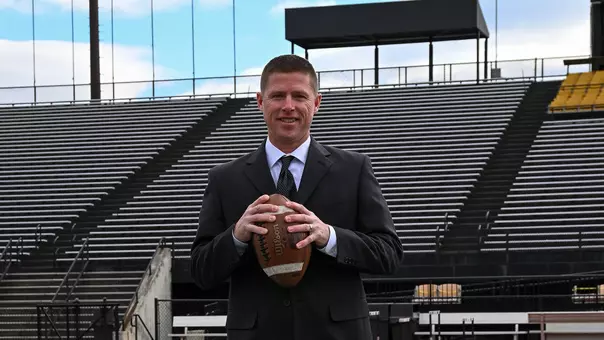
He coined the term “Marauder Pride.” His victories and championships over a 30-year career at Millersville earned him a spot in the College Football Hall of Fame. And even 30 years after his retirement, Dr. Gene A. Carpenter is synonymous with Marauder football and revered not just for the on-field triumph but his lasting impact on the thousands of young men who played for him and went on to become husbands, fathers and leaders in businesses and the communities. Carpenter is a legend.
But that was hardly the narrative in the summer of 1977 as Millersville prepped for what Carpenter predicted would be a “trying season.” Sure, Carpenter inherited a moribund Millersville football program (six consecutive seasons at .500 or worse) and turned it into a respectable, competitive team in short order. For the first half of the 20th century, Millersville’s powerhouse basketball team captured the hearts and attention of Marauder faithful and deservedly so. The basketball team won 13 “state titles” between 1927 and 1958. The Millersville gridiron was more like a graveyard for coaches. After Charles Cooper stepped away from his post as the team’s head coach in 1910, Millersville burned through 15 coaches in the next 60 years, only two of which lasted more than five seasons. Only Ivan Stehman, who coached from 1938 until the start of World War II, finished with a winning record. Even George Katchmer, the man who coached the Marauders for the 16 years prior to Carpenter’s arrival, told the Lancaster New Era during the 1977 season that “at one time it was a joke when teams came to play Millersville.” Carpenter went 4-5 in year one (1970) and a solid but unspectacular 38-20-1 from 1971-76. The Marauders finished second in the PSAC East five times in six seasons. Even after coming oh-so-close to giving Millersville its first division title, local scribes viewed Carpenter more as the coach who couldn’t win the big one rather than the hall of famer he became.
Upon Carpenter’s hiring at the age of 30, then-athletic director Larry McDermott tried to provide a dose of reality to the fiery, young, optimistic former U.S. Marine. Rumor is that McDermott assured Carpenter that he wasn’t expected to beat West Chester and East Stroudsburg—just stay competitive with the other schools in the conference. Well, for the first seven years of Carpenter’s run, McDermott’s expectations were met and not exceeded. Carpenter posted a 3-11 record against West Chester and East Stroudsburg and a 39-9-1 record against everyone else. In 1973, Millersville’s only two losses—by a total of nine points—came to those two teams. In 1974, Millersville trounced East Stroudsburg 23-0, but fell short of the elusive PSAC East title because of a loss to West Chester—a loss so emotional that Carpenter reportedly broke down in tears in the locker room. The following season, Carpenter gave Millersville its first win over West Chester since 1921, but high hopes crumbled in a heart-wrenching 28-24 loss to the Warriors in which Millersville blew a 17-point lead. Millersville finished that 1975 season 8-1. In 1976, Millersville went 4-2 in the East with losses to, you guessed it, West Chester and East Stroudsburg.
The sports pages not-so-subtly reminded readers of that notion. “Long suffering,” possessing a “loser’s image,” “nightmare that depicts a good MSC team playing for the championship—and losing,” were some of the ways the program was described even into Carpenter’s eighth season on the job.
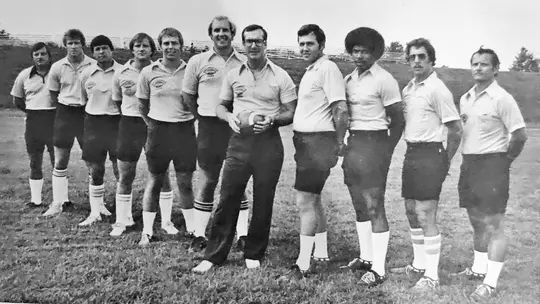
Despite the needling in ink, Carpenter remained resolute. It seems as if McDermott’s directive never sat well with Carpenter. During his introductory press conference at Millersville, Carpenter made no excuses and hedged no bets. “I’m not coming here to be 3-6 or 4-5. We want to win a conference championship someday,” he said. “It can’t be done overnight; it will take time…But if we’re given a fair chance to compete with the teams we play, I think we are going to have a winner.” Eight seasons later, in October of 1977, Carpenter told The Snapper, “You know, we’ve been knocking on the door for a long time, and we’ve never gotten in…if we keep knocking, we’re gonna get in.”
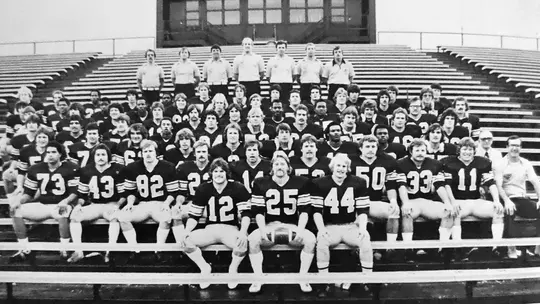
The door blew off the hinges in 1977. The 1977 team changed the perception of Millersville football. “A Winner at Last” read the bold Lancaster Intelligencer Journal article the day following Millersville’s emphatic, PSAC East-clinching win over East Stroudsburg. The team altered the course of events for the next 20 years of Millersville football. The team slayed the beast that was West Chester. The team won Millersville’s first PSAC East Championship, and in doing so, impugned the belief that Millersville football was nothing more than a middle-of-the-pack program. The team let the region know that Millersville was a program to be reconned with. The team paved the way for PSAC East domination as it won titles in 1979, 1980, 1981, 1988, 1989, 1990, 1993, 1995 and 1998 and made six NCAA playoff appearances.
In 1977, Carpenter, an unwavering football perfectionist who was described in the Lancaster New Era as a man whose “idea of heaven on earth was being a drill instructor in the U.S. Marine Corps,” finally got his championship. Not only did Millersville beat West Chester and East Stroudsburg in the same season for the first time, it utterly dominated both PSAC East powers, winning by scores of 28-7 and 34-8. The feat, considered so monumental for the Marauders, that a New Era writer likened it to a daring military assault.
“Eight years ago, when it looked like anything short of a Marine landing could rescue the Marauder football program, which had never won a title of any kind in its 81-year history and hadn’t beaten arch-rival West Chester in half a century, back when Carpenter first stormed into Millersville, a 30-year-old with a crewcut…he would have never figured it would take him eight seasons to bring home a title.”
“Millersville was thoroughly out-classed until only recently. Since Dr. Carpenter assumed the helm in 1970 have Millersville teams represented a genuine threat to the West Chester-East Stroudsburg hegemony,” wrote Tim Getzloff in an edition of The Snapper immediately following the Marauders’ win over East Stroudsburg. “And now, MSC is on the small college Eastern football map. No longer a punching bag but a respected, if not feared, opponent.”
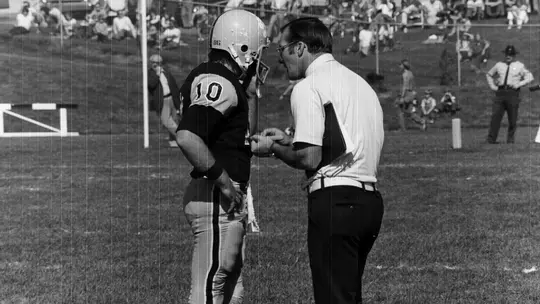
1977 became a turning point for Carpenter’s program. No longer saddled with the weight that comes from finishing second, the era of Millersville football that proceeded came to be defined by the phrase “the difference pride makes,” a .779 in-division winning percentage, and an undeniable aura of success that permeated the campus and community for 23 years. The 1977 PSAC East Championship came as the result of a slow and steady rise continually pushed forward by Carpenter’s unrelenting discipline.
“…if some of the players don’t already know it, they will discover shortly after practice begins that the new coach’s basic football philosophy can be summed-up in one word—discipline,” read the Lancaster Sunday News the morning after Carpenter’s hiring.
“Athletics is one of the last areas of discipline left in our country,” said Carpenter in the same story. “It takes a lot to be a winner, a lot of sacrificing. We’re going to be demanding a lot. Our players will have to be players first and they’ll have no special privileges. I feel the longer and harder a player works during the week the tougher it will be to quit on the day of a game.”
That was Carpenter’s mentality on day one, and it never changed--especially not in those early days as he remade the culture of a downtrodden program.
“It’s a pretty structured program,” said Carpenter in 1977. “Look, I never wanted to run a popularity contest. I want to do what I believe in; go by the principles I stand for.” The same New Era article added, “He set the example, and his players followed. Some didn’t buy it and they left. But the ones who stayed were his kind of people.”
Players left in droves. Life as a Marauder football player under Carpenter was not easy. For those few players who survived preseason in the sweltering August heat and the practices that seemingly never ended, it became a point of pride. You truly earned your spot as a Marauder.
“Sure, he was as tough as all hell, and there were very tough times, but there was a positive nature that was on the field, and the camaraderie. He would not stand for anything but that,” said Don Humphrey ’80, an All-PSAC East wide receiver and sophomore on the 1977 team. “Hundreds of people fell by the wayside over the four years, and coach would always talk about those guys and remind us what it took to keep up with what it took to be a champion. To hear that message, to know that you are in a certain group of four-year people to make it through that time, it was very gratifying.”
“It was just like the Marines in a lot of ways,” said three-year starting center and 1977 team captain Jerry Hoff ’78. “The summer camp was going to be harder than the real deal. It was your job to show up in shape. One day we were running sprints, it was August, really humid, and (Carpenter) said ‘look at this as an opportunity to run these (40-yard sprints). Anybody can be at the beach. Only special people can be here.’”
“While we hated Carpenter, we loved Carpenter,” said Dave Garrett ’80. Garrett suffered a career-ending injury as a high school football player but served as the team’s manager for four years and remained close to Carpenter and the program well after graduation. Carpenter was fond of saying “practice doesn’t make perfect, perfect practice makes perfect.”
“We had a thing called ‘10 perfect plays’ at the end of every practice,” said Garrett. “Carpenter was the judge. 10 plays became 100. Maybe a guard didn’t pull at the right time. We’d run it again and again. We all thought, ‘come on, we know what we are doing,’ but that’s why we had so much success, because of the expected excellence. But there wasn’t ever a time that he didn’t have our best interest at heart. He pushed us way harder than we wanted to be pushed but in the end you see the results.”
“If you didn’t get everything about that play exactly right, you might run it 50 times,” said Humphrey. “Everyone remembers the hills, running them at the end of practice. You’d be on the 25th time running a slant or an option, and you knew you were going to die running those hills. It was a desire for perfection. We wanted to work hard and didn’t want to let our team down.”
Carpenter’s kind of people—in both talent and personality--filled the 1977 roster. The players came from all backgrounds and from all corners of the state.
“Coach did a good job zeroing in on the type of player he wanted,” said Hoff. “Maybe we were a little undersized for the big schools but still talented. When I look back on it, we had a nice mix on our team. We had some guys from the coal towns. They were as tough as nails. Here’s the ball, run through that wall. They’d say ‘yes sir,’ and boom, there they’d go. We had city kids from Philadelphia, Harrisburg and Pittsburgh. They were tough dudes in another way. Then we had the suburban guys, from Lancaster and York counties who had gotten some better coaching in high school. Coach had a way of getting that mix to work together.”
Ironically, the beating heart of the 1977 team, quarterback Carmen Lex, played his high school football at Sun Valley, just 14 miles from the West Chester University campus. A news article written in 1977 said that Carpenter “stole him right out from under (West Chester coach John Furlow’s) nose.” There was no excuse for Furlow to whiff in the recruitment of Lex. After all, Lex’s brother took Furlow’s daughter to the prom.
“Gene has a very hard-working staff. They’re getting players we’d love to have; guys like Carmen Lex,” admitted Furlow.
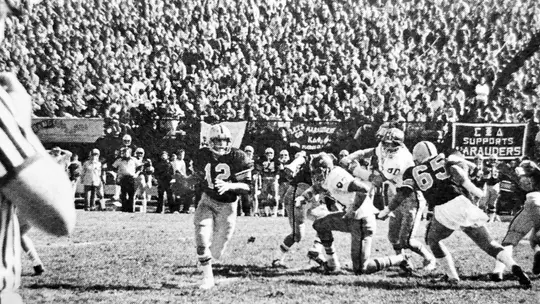
At 5-10 and 175 pounds, Lex was hardly physically imposing yet his teammates viewed him as a giant in the locker room and in the huddle. He won their admiration through sheer toughness, production and above all, confidence.
“Everything went through Lex,” said Will Lewis ’80, a Millersville Athletics hall of famer and sophomore on the 1977 team. “He didn’t have a statuesque figure. He was a little bit undersized but had a big arm, big hands, tons of confidence.”
“He commanded the field, commanded the huddle; an absolute leader with wonderful football intelligence,” said classmate, fellow team captain and running back Gordie Speicher ’78. “He was a take-charge guy, which you need in a quarterback.”
It was not uncommon for Lex to receive a play from the sideline, ignore the order and call his own play. And as domineering as Carpenter could be, he allowed Lex the freedom to think and feel the game. That was the respect he had for his quarterback.
“Carmen had that self-confidence,” said Hoff. “He was willing to push that off to the rest of us. He truly believed we could do it. ‘We’re going to make this pass; we’re going to get this first down.’ He wasn’t the biggest guy. He wasn’t the fastest guy. He led by example. He wasn’t afraid to bark at us.”
Hoff remembers Lex, after taking a particularly hard hit, pulling the clumps of turf and dirt out of his face mask and throwing it at his offensive lineman, shouting “you guys are going to get me killed!”
But Hoff was OK with that. He saw the licks that his quarterback took snap after snap running the Veer offense and how he battled through an untold number of injuries to lead the team to wins in games that he never should have suited up for.
Lex played the entirety of the 1977 season with a chipped bone in his foot. The injury dogged him so much that after a season-opening 28-7 loss at reigning NAIA champion Westminster, Lex didn’t practice the entire week leading up to the nationally televised NAIA “Game of the Week” at Slippery Rock. The Marauders lost to Slippery Rock 28-17 at home the year prior, and with the season in the balance just two weeks in, and playing without Speicher, who separated his shoulder in week one, Lex battled through the pain, guiding the offense to four touchdowns in the first five offensive drives and a season-altering 35-0 romp.
“This is a real shot in the arm for our team,” said Carpenter after the win. “We have been through a lot the last couple of weeks. The kids now believe in themselves.”
The team certainly believed in the power of Lex, or “Flex,” as he was nicknamed by Mac Rutherford of the Lancaster Intelligencer Journal after an epic performance against Kutztown—a game Carpenter called “the greatest game ever played at Millersville.”
Lex connected with sophomore wide receiver Aaron Wyley for a 76-yard touchdown pass on the first play from scrimmage. He rushed for 89 yards and passed for 195 while back-up running back Dave Pack rumbled for 113 yards. Millersville led 34-12 before Kutztown scored 20 unanswered points. The game remained in the balance until two-time All-America safety Bob Parr broke up a key pass on a late Kutztown third down. The finish of the game was so exciting that Carpenter reported his wife, Sandy, ran to the field and kissed him. Team doctor F. Wendell McLaughlin allegedly told Carpenter, “Sit down, Gene, and unwind before we have to send you to the hospital.”
Later that season, against Bloomsburg, Lex completed 21-of-32 passes for 304 yards, and on one scramble to the end zone he leaped for the goal line, was upended by a defender and landed on his head. Immediately following the frightening crash landing, the team trainer sent Lex to the hospital for x-rays on his neck. Lex returned to practice on Monday and never missed a snap.
“When I get hit hard the first thing I do is get up,” said Lex in 1977. “I didn’t want to acknowledge pain so opponents can’t see weakness.”
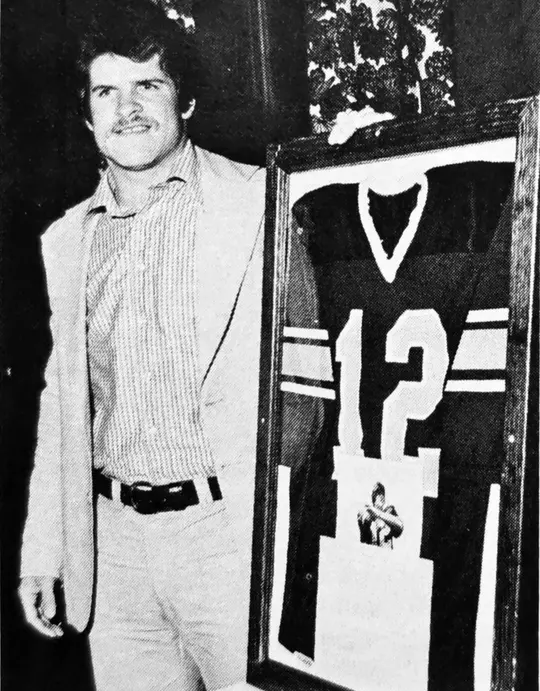
Carpenter so revered Lex that the coach retired the No. 12 jersey. No Marauder has worn it since.
Lex took plenty of hits. In the Veer, the quarterback is a decision-maker. He reads the defense and quickly decides to hand the ball off, keep it, or pitch it to another running back. Holding the ball until the very last instant—even as a bone-crushing hit is delivered—is often key in executing the pitch.
Lex rushed for 351 yards and six touchdowns in 1977, ranking fourth on the team in rushing yards and second in touchdowns. The Veer, Wishbone and Wing-T were the choice offenses of the era. Lex’s offensive numbers seem paltry by today’s standards, but for the time, Lex’s dual threat ability was quite unique. His 100 completions in 181 attempts, 1,629 yards and 16 touchdowns all stood as school records until 1991. Millersville set a school record for point scored and led the PSAC in total offense, passing offense and scoring offense in Lex’s senior season of 1977. By comparison, East Stroudsburg’s Mike Terwilliger, who eventually became the longtime offensive coordinator at the school and fathered the program’s current head coach, Jimmy Terwilliger, completed just 56 passes and threw three touchdowns all season.
Carpenter switched to the Veer prior to Lex’s sophomore season and grudgingly incorporated more and more passing simply to take advantage of his quarterback’s skillset and his outstanding wide receivers: Don Humphrey and Aaron Wyley.
In 1977, empty backfield, five receiver sets were unheard of. Teams loaded up with two and sometimes three running backs in the backfield with one wide receiver and a split end on the outside. Humphrey and Wyley were very different players but perfect compliments in Millersville’s extraordinary passing game.
“Throwing the ball made Carp extremely nervous,” said Lewis, who spent over 20 years working as an executive in professional football. “He was from the old school and wanted to run it. But the offensive coaches found a way to take advantage of the talent we had.”
Humphrey, a hyper, fast-talking kid from North Jersey stood 6-1 and became a three-time All-PSAC East selection with his route running technique and by catching every pass thrown his way. Garrett laughed that the team’s biggest expense aside from uniforms were all the cans of Stickum that Humphrey used. Joking aside, Humphrey totaled 506 yards receiving in 1977 and led the team in yards as a senior in 1979.
Wyley, aptly nicknamed “Fly,” was the team’s speedster and deep ball threat—a rare dynamic in an age of three yards and a cloud of dust. One of eight brothers and sisters, he came to Millersville, a school he’d never heard of, from Pittsburgh after former Millersville football player and future admissions director Gene Lyda visited his high school. Wyley’s parents didn’t want him to play football, but he was good enough to receive offers from Eastern Kentucky and West Virginia. Wyley decided on Millersville, and after three All-PSAC East First Team selections, school records for catches and yards in a season, career yards and career touchdowns, he earned a spot in the Millersville Athletics Hall of Fame. Wyley, as a sophomore in 1977, broke out with 35 catches and 702 yards with a school record nine touchdowns. His longest reception of the season was an 86-yarder. Aaron passed on his athleticism to his son, Rob, who played basketball at Millersville.
“Carmen was an accurate passer,” said Lewis, who practiced against the wide receiver duo every day. “Don Humphrey was the possession-type of guy--outstanding hands, could run every route in the route tree. You look at Fly, he was a track guy. That was his thing. People who underestimated Fly were taught a lesson. It took him three of four strides and he was gone. He could run by everybody. Fly played basketball, football and ran track, and he was outstanding at all of those sports.”
“We complimented each other very well,” said Humphrey. “We were good friends. We were different types of players. You had a slower, possession-type receiver, and you had the speedster on the outside who would be your long ball guy. Our only competition was both of us wanting the ball all the time, just like any receivers.”
While the record-setting offense stole the headlines, an inexperienced defense more than held its own, allowing just 13.9 points per game and holding six opponents to no more than 12 points. The unit shutout Slippery Rock and Cheyney and held rivals West Chester and East Stroudsburg to a combined 15 points. The 5-2 defense, coordinated by Bill Lauris, ranked third in the nation in 1974 but seemingly faced a rebuild as it returned just five letterwinners and boasted just three seniors. An extremely talented group of sophomores and a couple of star freshmen made an immediate impact.
In a time when it was fashionable for men to follow the rock star trend and match long, shaggy hair worn over the ears with unkempt mustaches, sophomore linebacker Chuck Bachert, with a crew cut and cleave shave, looked like he was fresh out of Carpenter’s Marine boot camps. A Carpenter kind of guy, no doubt. The 6-2, 220-pounder from Allentown just looked like a linebacker with his build and square jaw. After playing sparingly on the varsity in the latter half of his freshman season, Bachert piled up a team-leading 121 tackles—a record that stood for two years until classmate Mike Marcks broke it. Bachert earned All-PSAC East First Team honors in ’77 and ’79 and a second team selection in ’78. Bachert graduated with a school record 332 career tackles, but Marcks remarkably broke that record as a middle guard two years later.
For an interior lineman, Marcks was incredibly undersized at 5-11, 209 pounds. But he found a way to make plays. He started as a true freshman, and in 1977, he totaled 103 tackles (the most ever for a Millersville defensive lineman), recovered three fumbles, intercepted a pass and swatted down three passes. Teams did not record sacks as a statistic in 1977, but in the first season that it became recognized, Marcks totaled 16.
“Chuck Bachert and Mike Marks were freaking studs,” said Humphrey. “They were studs who helped the team tremendously. They were severe competitors.”
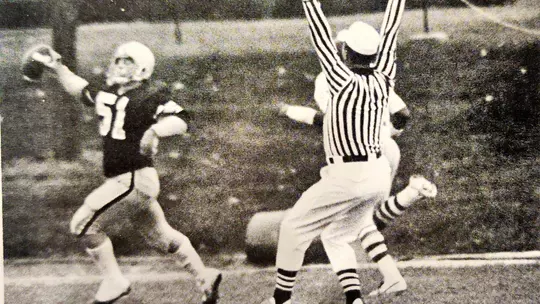
Other than sharing Allentown as a hometown and intense on-field competitiveness, senior safety Bob Parr was in every way the antithesis of Bachert. If he wasn’t the defense’s most talented player, he was its most violent, reckless and attitudinal. Parr, a 1977 team captain and a two-time All-American, wore dirty blonde hair that fell to his shoulders and a corresponding mustache, giving him the appearance of someone much older than his 22 years. He drove around campus in a black Cadillac convertible. Garrett described him as a “loose cannon.”
“He could hit harder than anyone I’d ever seen,” said Garrett. “He was the most fearless player I’d ever seen. He wasn’t a guy you’d want your daughter to marry but as good as it comes on the field. He’d go through his mother to make a tackle.”
Marv Adams of the Lancaster Intelligencer Journal wrote of Parr, “He’s the kind of young man you’d most likely want to walk through a dark alley with or have on your side in a scrap.”
Carpenter said, “If I ever had a player who had no respect for his body, it’s Bob Parr. I would say he’d fight at the drop of a hat, and he’d be the one who drops the hat.”
“He came like a lightning bolt,” said Hoff, who played with Parr for four years. “He would hit you. He was a very talented guy. Not the biggest in the world, but he lowered a boom, and he was really mouthy about it.”
Parr backed up his trash talk with his play and gave the Marauders some serious swagger. In 1976, West Chester wide receiver Joe Senser, a huge 6-5 target who eventually became a Pro Bowl tight end with the Minnesota Vikings, ran wild, scoring three touchdowns in a 43-14 whipping of the Marauders. In ’77, Parr, despite giving up six inches in height, took on Senser as his personal assignment and followed the West Chester All-American all over the field in man-to-man coverage. Parr reportedly walked up to Senser before the first snap and told him, “if the ball comes to you, you’re gonna get hit. I’m going to lay you out.”
Senser finished the game with three catches—a total non-factor as Millersville won handily.
“Our All-American on their All-American and our man won,” Carpenter said to sportswriter Mac Rutherford after the game.
While Parr brought the intensity, his fellow safety Jim Olivere provided the levity. The 1977 media guide described Olivere as a “very steady, dependable young man.” Lewis remembers him as one of his favorite teammates.
“He wasn’t a talented player, but he was always in a good mood. He would sing Frank Sinatra songs every day in the locker room before practice. He had a quick wit, great sense of humor. He kept it light. I enjoyed watching him in practice.”
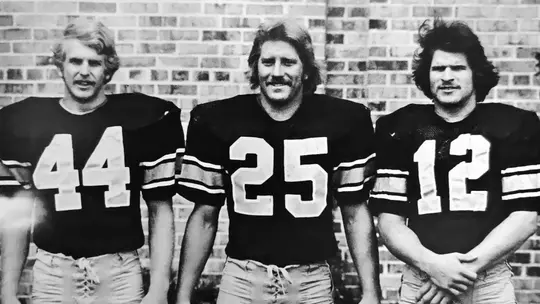
Joining the odd couple of Parr and Olivere in the defensive backfield were cousins and otherworldly athletes: Lewis and Robb Riddick. Amazingly, both players went on to enjoy successful NFL careers. Lewis played for the Seattle Seahawks while Riddick eventually switched from cornerback to running back and played six seasons with the Buffalo Bills. He served as Thurman Thomas’ primary back-up during the 1988 season in which the Bills won their division with a 12-4 record.
Lewis and Riddick possessed physical abilities never seen at Millersville University. Asked when he knew that Lewis and Riddick were a different breed, Hoff matter-of-factly said “the first day of practice.”
Lewis arrived in 1976 as a scrawny 5-9, 160-pound freshman. He played some at cornerback his freshman season but packed on muscle and became more comfortable with the game as a sophomore. Riddick (misidentified as Bob Reddick in the 1977 media guide) arrived at campus in August of 1977 as a mature 20-year-old, 6 feet 2 inches and sculpted.
“With Riddick, it was obvious from the first time he stepped on the field,” said Garrett. “He was a caliber of an athlete that how he got to Millersville I have no idea. On the first day of preseason camp we had the Oklahoma drill. No one wanted to go against Bob Parr because he’d kill you. Carpenter put him against Riddick. Bob didn’t win. That was when you realized he was a whole different player. He could play basketball, dive, swim, run track; he was the most gifted athlete.”
Riddick made an immediate impact on the Marauders’ defense, intercepting a team-high five passes which tied a school record set by Parr two years earlier. Lewis tied the record in 1978 and broke it with seven in 1979.
An overpowering offense coupled with a young but talented defense to create a dream season—a season for which Carpenter had started building in 1970. But the season didn’t come without drama. The 21-point loss in the opener to NAIA powerhouse Westminster saw the Marauders fumble a punt and miss two field goals. “We have a young team and made a number of young mistakes,” said Carpenter. He said before the season started that he was tired of finishing second, and the defeat did nothing for his peace of mind. “I’ve never been so frustrated in my life,” said Carpenter following the game.
The team grew up in a hurry, though. The national TV victory over Slippery Rock, the thriller against Kutztown and statement win under the lights at West Chester set Millersville on the inside track for the PSAC East title. Even before kickoff against West Chester, Millersville had heard that East Stroudsburg lost in an early game. Seeing a win as an opportunity to take hold of the East created nerves and a slow start followed. Millersville trailed 7-6 until Adolph “Bubba” Wright blocked a punt. Two plays later, a returning Speicher scored a touchdown, and Carpenter dug into his bag of tricks, calling on Speicher to throw for a two-point conversion. That play proved a turning point as Millersville reeled off 28 consecutive points. Speicher finished with three touchdowns and clinched the game on a “breathtaking 39-yard run.”
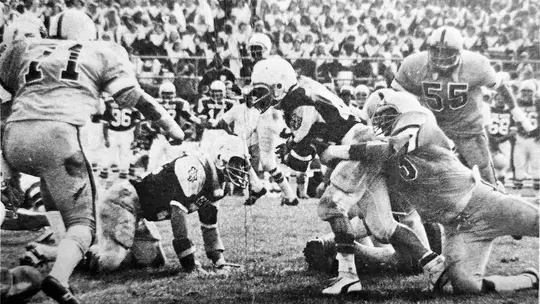
The Marauders rolled through Mansfield and Bloomsburg, setting up the pivotal East Stroudsburg game which just happened to be the Warriors’ homecoming. Carpenter didn’t hide from the importance of the game. He told Rutherford in the game preview story that “it would be our biggest win ever, and there is no question that this is the biggest game for Millersville since I have been here.”
East Stroudsburg entered the game with the No. 1-ranked defense in Division II, allowing 5.8 points per game and a mere 86 passing yards per game. Millersville, meanwhile, averaged 237 rushing yards and 177 passing. The game was never close. The Marauders exorcised the demons of past second-place finishes in a brutally efficient manner. East Stroudsburg’s first drive reached the Millersville 12, but Riddick smashed Terwilliger to the turf for a two-yard loss, and the Marauders blocked the field goal attempt. A Lex to Humphrey touchdown connection made it 24-0 before East Stroudsburg scored.
“They went through Stroudsburg like a team of surgeons,” wrote Getzloff in The Snapper.
“It was a big deal,” said Speicher, who had lived through the heartbreak of past losses to East Stroudsburg. “We had lost to East Stroudsburg before, and they went on to win the East. Carmen said this was the one team he hadn’t beaten as a starter at Millersville. We felt like we needed to beat them. It was the game to get over the hump.”
A campus celebration befitting a championship team ensued when the conquering heroes returned.
“There was the biggest bonfire and attendance at a pep rally I had ever been in,” said Hoff. “Coach got up there and dragged a couple of us seniors with him on a platform to address the crowd. It was mind numbing. It was like the whole stadium came.”
Millersville clinched its first Eastern Division title, but two games and three weeks remained until the PSAC Championship game, or “state game” as it was so often referred to. Millersville routed Cheyney while Wyley set the season record for touchdowns with two in the game. Millersville faced the reigning Western Division champs, Edinboro, in the regular season finale. Edinboro entered the game allowing just 11 points per game, but Lex, even with cotton balls shoved in both nostrils to stop the bleeding of a busted nose, threw two touchdown passes for the single-season record.
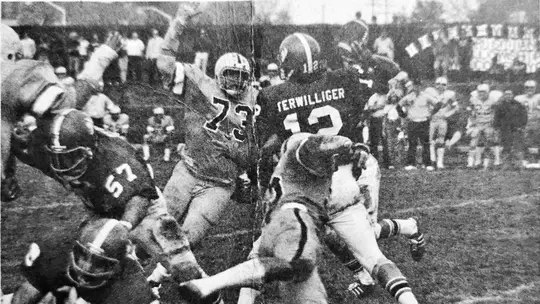
Through nine games, Millersville was 8-1, undefeated against PSAC teams, and the season was already unequivocally the most impressive season in program history. Yet a PSAC Championship and a likely berth to the NAIA playoffs was on the line at Biemesderfer Stadium against a Clarion club that was 8-0-1, fresh off a 14-14 tie with Slippery Rock (a team Millersville beat 35-0 in week two) the prior week in a blizzard. No team had scored more than 14 points on Clarion, and it boasted the No. 2-ranked defense in the country, allowing a measly 7.8 points per game.
Millersville averaged an unheard of 418.3 yards per game, so fittingly, the newspapers hyped the game as an offense vs. defense showdown. Prophetically, however, the pregame stories hardly mentioned Clarion’s offensive personnel. Instead, they glorified placekicker Bill May, “the Golden Toe,” who had converted 14 field goals during the season including an NCAA record five against IUP. May, a freshman in 1977, went on to be a four-time All-American and an inductee of the Clarion Hall of Fame in 2006. He held every PSAC kicking record when he graduated.
Another question for the Marauders was if the undersized senior center Hoff could handle Clarion’s star middle guard, Ed Arndt, who had recorded 15 sacks.
Carpenter stated that he expected Clarion to play the game close to the vest. Clarion coach Al Jacks admitted, “If they get more than two touchdowns, we’ll have our hands full.” Rutherford hyped it as the biggest game in Millersville history.
“We were riding high,” said Speicher. “We had the confidence going, winning eight in a row. We had beaten Slippery Rock and Edinboro in the West. We knew Clarion was a very good team.”
Millersville’s Biemesderfer Stadium filled early and quickly. A buzz filled the autumn air, even as the Marauders entered the field for pregame warmup.
“I remember coming out of the tunnel onto the field for warmups, and it was already the most fans I’d ever seen,” said Speicher. “It was packed, people on the grass all the way around the stadium.”
“I was at a height of combined anxiety, nervousness, motivation, built into one that whole week,” said Humphrey. “Every practice seemed to get to a higher level of intensity.”
The game started exactly how Millersville had hoped. Hoff fired off the line and buried Arndt five yards downfield on a run play. Millersville built a 17-8 lead and led 24-15 in the third quarter. Speicher rushed for 178 yards in the game, scoring on touchdown runs of 49 and 69 yards. But while Carpenter expected a conservative game plan from Clarion, Jacks, a former Penn State quarterback, spent the week retooling his offense. The Lancaster Intelligencer Journal article called it a “junk offense,” as Jacks moved a wing back from the slot into the backfield, a look Millersville had never before seen, making the Marauders more cautious and less reactive on defense. Jacks also pulled off some trickery, running a fake punt and a trick two-point conversion for Clarion’s first score.
Millersville clutched to its late lead but made its share of mistakes. The Marauders had a punt blocked and lost two fumbles including one late after stopping Clarion on a fourth-and-inches. Clarion’s Jay Dellostretto caught a fourth quarter touchdown pass from Bob Beatty to make the score 24-22, and after Millersville failed to run out the clock, Clarion took over possession with just over a minute remaining.
With timing ticking away, Beatty completed a 12-yard pass to the Millersville 27-yard line right in front of the Clarion bench. Riddick made the stop, knocking the receiver out of bounds. A penalty flag came flying, and the call was a personal foul for roughing. The controversial call put May within chip shot range.
The Snapper quoted an “unbiased spectator” who sat on the hill with an alleged clear view of the play. The fan reported that it was “indisputably a bad call.” Rutherford described it in the Intelligencer Journal as Riddick hitting Dellostretto on the head with his arm after going out of bounds, but a Clarion article credited Dan Kohley, not Dellostretto, with the catch.
Hoff watched the film and determined that Riddick didn’t do anything differently than he had the entire game. “Wrong time, wrong place, right in front of their bench,” said Hoff. “We thought we had the game. They were outside of anyone’s range.”
Carpenter remained diplomatic about the penalty. “It was a mistake, one of many we made. It just happened at a bad time.”
Carpenter called timeout with seconds left in an effort to ice May, and the strategy nearly worked. May’s kick was on target but hit poorly. Even from 29 yards, May’s kick barely cleared the crossbar—an excruciating finish for the Marauders.
“It was the longest two seconds,” Speicher said about watching the ball in flight.
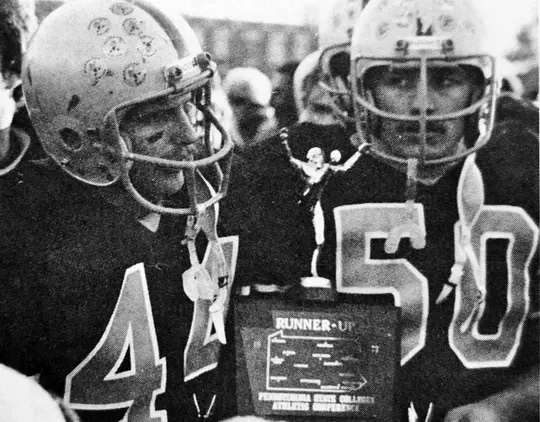
How do you describe that feeling? When a feat so unattainable for the nearly 100 football teams that came before is so close but slips through your grasp?
“It was devastating,” said Speicher. “They had the trophy presentations, and I remember looking around me and not many teammates were out there. I remember bringing the trophy in and setting it down on the floor of the locker room.”
“Carmen really took it hard,” said Hoff. “Gordie and I had the trophy handed to us. It was really depressing. Felt like we let a lot of people down.”
“Extreme disappointment,” said Humphrey.
For some, the disappointment from the loss lasted hours. For some, days. For some, longer. But when those teammates talk today, conversation doesn’t center on the “state game.” They reminisce about locker room jokes and the personalities, recalling those “Carpisms” and the tidbits of wisdom only Carpenter could hand out. They fondly remember the challenging practices, how they survived and became better for it. They catch up on family and life. And yes, they proudly recall thumping West Chester and East Stroudsburg.
The one-point loss could never overshadow the importance of the 1977 team to the future of Millersville football. That team can always say they won Millersville’s first PSAC East Championship.
“Coach Carpenter’s ending commentary after the game was ‘thank goodness for the seniors who brought us to this level even though we fell short,’” said Speicher. “’And to all the other guys here, you saw such a great example (of leadership).’”
“For the younger players, the tradition continued on from there,” said Lewis.
“From that point, it tripped the wire for the program,” said Hoff. “I’m sure it helped coach in recruiting. When you are a player you don’t think ‘what I’m doing today is helping the program down the road.’”
But it surely did. The championship tradition of “Marauder Pride” still echoes. It’s still meaningful. It still matters. And in many ways, it all started in 1977.