International Marauders bring diversity to Millersville field hockey
10/17/2018 1:13:00 PM | Field Hockey, Features
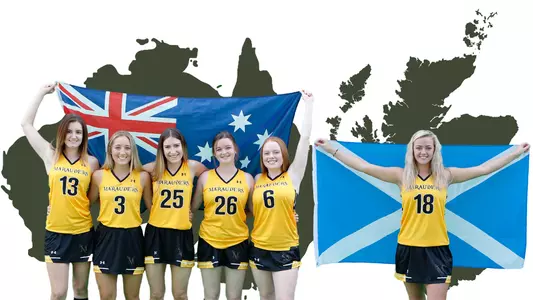
Millersville, Pa. - Being away from home for the first time is a fear every student has when they first go away to college. But most students get to conquer that fear in their home country. That is not the case for six members of the Millersville University field hockey team, who left home for the first time and traveled halfway across the world to earn their degree and compete at a collegiate level.
Annabelle Tierney, Natalie Pinder, Georgina Wall, Morgan Sudweeks and Niamh Murphy-O'Neil all hail from Australia, while Amber Macdonald came to Millersville from Scotland. Each player talked to an agency in their home country who put them in contact with head coach Shelly Behrens.
"Field hockey is a very international game," Behrens said. "Admissions and student affairs and enrollment management had discussions about making the campus more global, and our sport is great for that. I wanted to recruit players from other countries anyway, and when the university also wanted to go in that direction it was great timing. Then it was just a matter of finding the right people to come here."
There are a number of adjustments that need to be made when coming over from a different country, most notably the food. Portions are bigger in America and certain foods have different names, such as a chicken sandwich being referred to as a chicken burger and ground beef being called mint in Australia. The different accent is also a big adjustment. Murphy-O'Neil explained that it "took a solid two weeks to get used to it" and she initially thought "these people sound funny."
Some of the international players were also surprised with how rural the area is and expected a more city-like environment.
"All I had ever known of America is what you see in movies," Wall said. "But it's a bit unrealistic to expect the whole country to be that way. Even still, there's nothing else like this in the world. America does sports and college so well and I figured I should take advantage of this opportunity while I'm still young."
Tierney agreed that the opportunity to play competitive field hockey as a student was worth making the adjustments to a different country.
"In Australia they don't offer anything at this level of competition in college," she said. "After high school there's only professional club field hockey. Field hockey has always been such a big part of my life and it seemed like a perfect opportunity to get to go to school and play the sport that I love."
Pinder came to Millersville with Tierney from Australia in the fall of 2017, and she explained that their American teammates played a significant role in helping the Australians adapt to a completely new environment.
"Coming in and having a team behind me gave me a sense of belonging," Pinder said. "They quickly became my family. When I first came here I had no idea where anything was on campus, I didn't know any professors and I didn't know anyone else outside of my team. So it was really helpful to have them."
Study abroad students had previously donned the black and gold, but they were only on the team for one season. Tierney and Pinder were the first international students to join the field hockey team full time. Since their arrival, four more joined prior to the 2018 season. Murphy-O'Neil and Macdonald came to the Marauders as freshmen, while Wall transferred from the University of Tasmania and Sudweeks joined after spending one year at Converse College.
Having already adjusted to American life, Tierney and Pinder took initiative in helping their new teammates do the same.
"Having Natalie and Annabelle, who had already been through this process, helped and they gave me an expectation of what was to come from here," Wall said.
Behrens also credits Tierney's and Pinder's families with helping her international student-athletes adjust.
"They have provided a sense of credibility to the program to ease any concerns families who are sending their daughter to America may have. It's not lost on me that our parents are sending their kid halfway across the world," Behrens said.
Sudweeks, who had to go through the same process last year at Converse, has also been able to help her new teammates adjust, even though she has had to undergo her own adjustment of joining a new team.
"There were a lot of other international freshmen on my team at Converse," Sudweeks said. "I actually found it to be more difficult to come here than there. I was coming to a team here that was already established, but everyone was so supportive which made the transition a lot easier."
Outside of having to adjust to a new country and team, there are also quite a few differences between American field hockey and how it is played overseas. One of the biggest changes the international student-athletes had to adjust to was the playing surface.
In other countries, the surface is designed specifically for field hockey. But in America, other sports such as football and lacrosse often share stadiums.
"The biggest difference to me is the surface," Murphy-O'Neil said. "The game seems a lot slower on the turf than the surface I'm used to. I still find myself trying to find the right footing."
Pinder noted that there is also more contact in American field hockey than Australian field hockey.
"Shelly pointed it out to me, and I agreed that it's a more physical style of play over here," she said. "In Australia we finesse around people on the field, which is much different than how it is played in America."
Even the names of positions differ between each country. The term "flank" is used in certain parts of Australia, which refers to an outside midfielder. Terms vary even within one country; the east coast of Australia, where Pinder is from, uses the term "inner" as opposed to "flank."
The term "striker" is used in American field hockey, but not as frequently as it is used in Scotland. "Striker" refers to a forward, but the lone Marauder from Scotland is a midfielder.
The other international students have the benefit of having teammates from their country, but Macdonald still finds it very helpful to have teammates who also come from overseas, especially since both Scotland and Australia are part of The Commonwealth of Nations.
"Scotland is much more similar to Australia than America, especially in terms of what we call certain things," Macdonald said. "Having Australian teammates makes me feel closer to home and less of the 'odd one out.'"
Being around others who share one's homeland is comforting, but it's still easy for one to get homesick when they're halfway across the world from where they were raised. Sudweeks, whose hometown of Perth is as far as you can possibly get in the world from the east coast of America, finds comfort in a very simple activity: watching the sunset.
"Wherever you are in the world the sun always sets," Sudweeks said. "I've seen it so many times having lived on the west coast of Australia. Seeing it here reminds me of home."
There are also a handful of other international student-athletes at Millersville who have had to make the transition from one country to another, such as Jose Alcazar and Carlos Martinez-Lucas of the men's tennis team who both hail from Spain, and Chandera Jones-Aryeh of the women's basketball team who came over from England.
The majority of the students at Millersville don't leave their home state. But those who choose to leave their home country add diversity to a university who has made expanding its student population beyond the border of Pennsylvania a priority.
"Out of the country is definitely out of the state," Behrens said.
Behrens spent time traveling the world coaching field hockey prior to her arrival at Millersville in 2008, and her knowledge of the sport impressed all of her international players and made them want to become a member of her team.
"Shelly is very passionate about field hockey and she knows what she's talking about," Wall said. "She establishes a strong player-coach relationship and has faith in my abilities. She is very straight to the point and gives direct instructions, which I really like."
Perhaps the most important element of Behrens' coaching style is that she does not want any member of her team to change their style of play.
"I want to see what makes them great, and I don't want to see them trying to be what they think I want them to be."
"Last year I was trying so hard to adapt and play the style that all of my teammates around me were playing," Tierney said. "But Shelly would just tell me to play how I play. It's good to have two different outlooks on the game and be able to do both. It's not like we're playing a different game, it's just the style of how we play that's different."
Each international student-athlete brings diversity to both the Millersville campus and their respective teams, and Behrens believes that this is very beneficial.
"Isn't that the great thing about sports? You can make someone else better and they can make you better based on your differences," Behrens said.
While there may be many differences in both culture and playing style between America, Australia and Scotland, Behrens knows there is one thing all of her players have in common no matter where they were born: "They're all Millersville."
Annabelle Tierney, Natalie Pinder, Georgina Wall, Morgan Sudweeks and Niamh Murphy-O'Neil all hail from Australia, while Amber Macdonald came to Millersville from Scotland. Each player talked to an agency in their home country who put them in contact with head coach Shelly Behrens.
"Field hockey is a very international game," Behrens said. "Admissions and student affairs and enrollment management had discussions about making the campus more global, and our sport is great for that. I wanted to recruit players from other countries anyway, and when the university also wanted to go in that direction it was great timing. Then it was just a matter of finding the right people to come here."
There are a number of adjustments that need to be made when coming over from a different country, most notably the food. Portions are bigger in America and certain foods have different names, such as a chicken sandwich being referred to as a chicken burger and ground beef being called mint in Australia. The different accent is also a big adjustment. Murphy-O'Neil explained that it "took a solid two weeks to get used to it" and she initially thought "these people sound funny."
Some of the international players were also surprised with how rural the area is and expected a more city-like environment.
"All I had ever known of America is what you see in movies," Wall said. "But it's a bit unrealistic to expect the whole country to be that way. Even still, there's nothing else like this in the world. America does sports and college so well and I figured I should take advantage of this opportunity while I'm still young."
Tierney agreed that the opportunity to play competitive field hockey as a student was worth making the adjustments to a different country.
"In Australia they don't offer anything at this level of competition in college," she said. "After high school there's only professional club field hockey. Field hockey has always been such a big part of my life and it seemed like a perfect opportunity to get to go to school and play the sport that I love."
Pinder came to Millersville with Tierney from Australia in the fall of 2017, and she explained that their American teammates played a significant role in helping the Australians adapt to a completely new environment.
"Coming in and having a team behind me gave me a sense of belonging," Pinder said. "They quickly became my family. When I first came here I had no idea where anything was on campus, I didn't know any professors and I didn't know anyone else outside of my team. So it was really helpful to have them."
Study abroad students had previously donned the black and gold, but they were only on the team for one season. Tierney and Pinder were the first international students to join the field hockey team full time. Since their arrival, four more joined prior to the 2018 season. Murphy-O'Neil and Macdonald came to the Marauders as freshmen, while Wall transferred from the University of Tasmania and Sudweeks joined after spending one year at Converse College.
Having already adjusted to American life, Tierney and Pinder took initiative in helping their new teammates do the same.
"Having Natalie and Annabelle, who had already been through this process, helped and they gave me an expectation of what was to come from here," Wall said.
Behrens also credits Tierney's and Pinder's families with helping her international student-athletes adjust.
"They have provided a sense of credibility to the program to ease any concerns families who are sending their daughter to America may have. It's not lost on me that our parents are sending their kid halfway across the world," Behrens said.
Sudweeks, who had to go through the same process last year at Converse, has also been able to help her new teammates adjust, even though she has had to undergo her own adjustment of joining a new team.
"There were a lot of other international freshmen on my team at Converse," Sudweeks said. "I actually found it to be more difficult to come here than there. I was coming to a team here that was already established, but everyone was so supportive which made the transition a lot easier."
Outside of having to adjust to a new country and team, there are also quite a few differences between American field hockey and how it is played overseas. One of the biggest changes the international student-athletes had to adjust to was the playing surface.
In other countries, the surface is designed specifically for field hockey. But in America, other sports such as football and lacrosse often share stadiums.
"The biggest difference to me is the surface," Murphy-O'Neil said. "The game seems a lot slower on the turf than the surface I'm used to. I still find myself trying to find the right footing."
Pinder noted that there is also more contact in American field hockey than Australian field hockey.
"Shelly pointed it out to me, and I agreed that it's a more physical style of play over here," she said. "In Australia we finesse around people on the field, which is much different than how it is played in America."
Even the names of positions differ between each country. The term "flank" is used in certain parts of Australia, which refers to an outside midfielder. Terms vary even within one country; the east coast of Australia, where Pinder is from, uses the term "inner" as opposed to "flank."
The term "striker" is used in American field hockey, but not as frequently as it is used in Scotland. "Striker" refers to a forward, but the lone Marauder from Scotland is a midfielder.
The other international students have the benefit of having teammates from their country, but Macdonald still finds it very helpful to have teammates who also come from overseas, especially since both Scotland and Australia are part of The Commonwealth of Nations.
"Scotland is much more similar to Australia than America, especially in terms of what we call certain things," Macdonald said. "Having Australian teammates makes me feel closer to home and less of the 'odd one out.'"
Being around others who share one's homeland is comforting, but it's still easy for one to get homesick when they're halfway across the world from where they were raised. Sudweeks, whose hometown of Perth is as far as you can possibly get in the world from the east coast of America, finds comfort in a very simple activity: watching the sunset.
"Wherever you are in the world the sun always sets," Sudweeks said. "I've seen it so many times having lived on the west coast of Australia. Seeing it here reminds me of home."
There are also a handful of other international student-athletes at Millersville who have had to make the transition from one country to another, such as Jose Alcazar and Carlos Martinez-Lucas of the men's tennis team who both hail from Spain, and Chandera Jones-Aryeh of the women's basketball team who came over from England.
The majority of the students at Millersville don't leave their home state. But those who choose to leave their home country add diversity to a university who has made expanding its student population beyond the border of Pennsylvania a priority.
"Out of the country is definitely out of the state," Behrens said.
Behrens spent time traveling the world coaching field hockey prior to her arrival at Millersville in 2008, and her knowledge of the sport impressed all of her international players and made them want to become a member of her team.
"Shelly is very passionate about field hockey and she knows what she's talking about," Wall said. "She establishes a strong player-coach relationship and has faith in my abilities. She is very straight to the point and gives direct instructions, which I really like."
Perhaps the most important element of Behrens' coaching style is that she does not want any member of her team to change their style of play.
"I want to see what makes them great, and I don't want to see them trying to be what they think I want them to be."
"Last year I was trying so hard to adapt and play the style that all of my teammates around me were playing," Tierney said. "But Shelly would just tell me to play how I play. It's good to have two different outlooks on the game and be able to do both. It's not like we're playing a different game, it's just the style of how we play that's different."
Each international student-athlete brings diversity to both the Millersville campus and their respective teams, and Behrens believes that this is very beneficial.
"Isn't that the great thing about sports? You can make someone else better and they can make you better based on your differences," Behrens said.
While there may be many differences in both culture and playing style between America, Australia and Scotland, Behrens knows there is one thing all of her players have in common no matter where they were born: "They're all Millersville."

Players Mentioned

M
/ Field Hockey
F
/ Field Hockey
M
/ Field Hockey
M
/ Field Hockey
M
/ Field Hockey
F
/ Field HockeyHighlights: Millersville Field Hockey vs. #5 West Chester (October 29, 2025)
Wednesday, October 29
Highlights: Millersville Field Hockey vs. Mansfield (October 11, 2026)
Saturday, October 11
Highlights: Millersville Field Hockey vs. #1 Shippensburg (October 8, 2025)
Wednesday, October 08
Highlights: Millersville Field Hockey vs.Indiana University of Pennsylvania (October 4, 2025)
Saturday, October 04